Patta Chitta in Tamil Nadu: Meaning, Benefits, Documents & How to Apply Online
Anurag Sodani • June 29, 2026
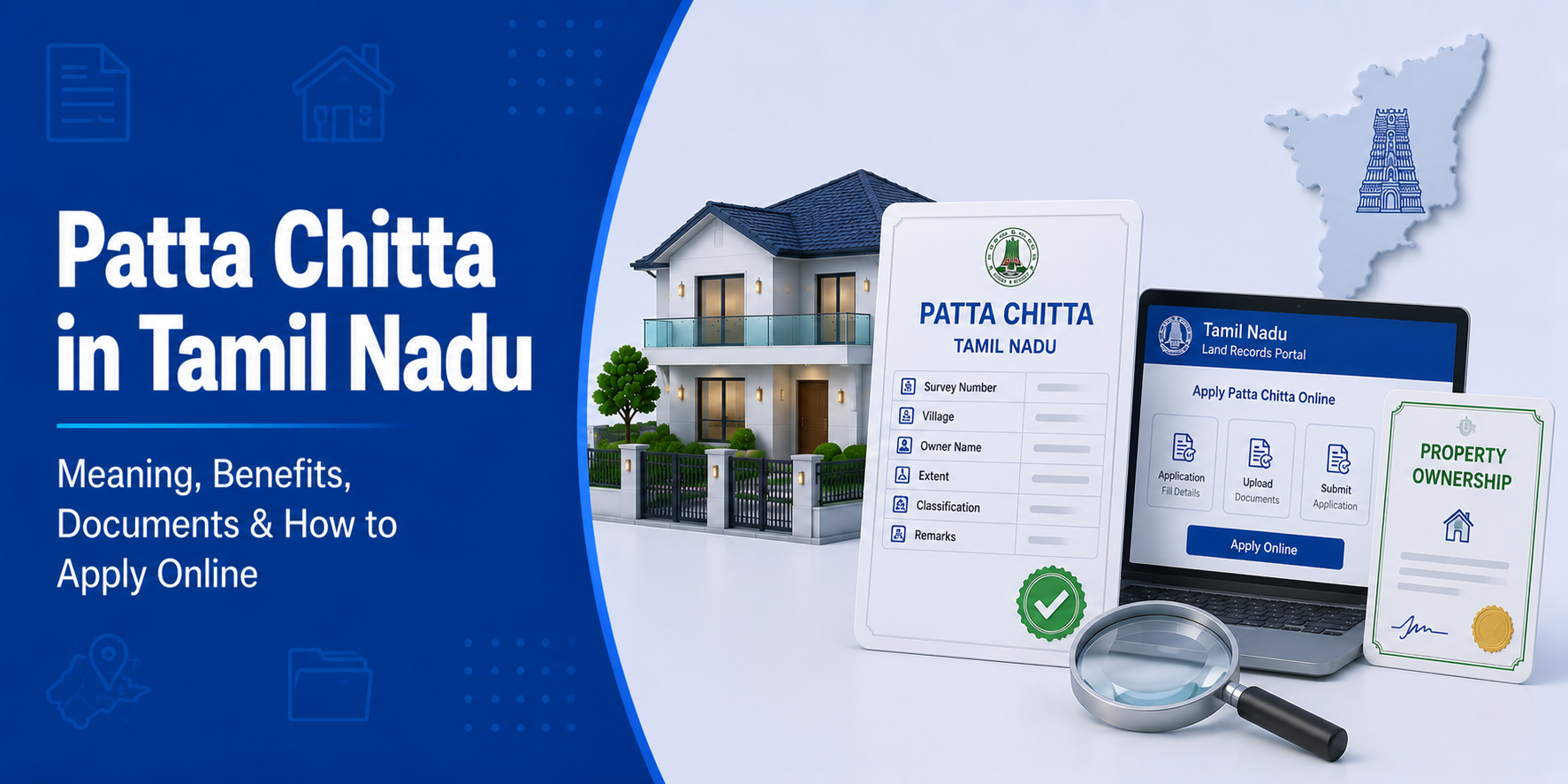

If you own land or are planning to buy property in Tamil Nadu, you will encounter two essential land records almost immediately — Patta and Chitta. Together known as Patta Chitta Tamil Nadu records, these documents serve as the official proof of land ownership and cultivation details maintained by the state government. Whether you are applying for a home loan, resolving a property dispute, or simply verifying ownership before a purchase — understanding Patta Chitta is non-negotiable.
What is Patta Chitta?
What is Patta?
A Patta (also called a Patta Passbook) is a legal document issued by the Tamil Nadu government that certifies ownership of a piece of land. It is maintained by the Tahsildar’s office and contains:
- Patta number (unique identifier)
- Name of the land owner
- Survey number and subdivision number
- Location (village, taluk, district)
- Land area and classification (wet/dry/garden land)
- Nature of possession (private/government)
Patta is essentially the government’s formal recognition that a specific person owns a specific piece of land.
What is Chitta?
Chitta is a register maintained at the village administrative level (by the Village Administrative Officer or VAO). It records:
- Name of the landholder
- Survey number
- Extent of land
- Type of land (wetland/dryland)
- Assessment (tax details)
Chitta is closely linked to Patta — both documents together confirm ownership and land details.
What is Adangal?
Adangal (also called A-Register or Village Account No. 2) records the nature of land use, crops grown, and cultivation details for a given survey number. When people refer to patta chitta adangal, they mean the combined set of ownership + land use records for a parcel of land.
Difference Between Patta and Chitta
| Feature | Patta | Chitta |
|---|---|---|
| Issued by | Tahsildar / Revenue Department | Village Administrative Officer (VAO) |
| Purpose | Proof of land ownership | Land classification & tax details |
| Contains | Owner name, survey no., area | Extent, type of land, assessment |
| Legal standing | Primary ownership document | Supporting record |
| Used for | Home loans, mutation, court cases | Verification of land type |
Note: Since 2015, Tamil Nadu has merged Patta and Chitta into a single document called Patta Passbook, accessible online via the eServices TN portal.
Types of Patta in Tamil Nadu
There are primarily three types:
- Private Patta — Issued to individuals for privately owned land
- Government Patta (Poramboke) — Land owned by the government; no private Patta is issued
- Gramam Natham Patta (கிராம நத்தம் பட்டா) — Issued for residential plots within village settlement areas (natham land). This type of Patta is specifically for house sites in villages, not agricultural land.
Eligibility to Obtain Patta
You can apply for a Patta or request Patta mutation (name transfer) if you are:
- A legal heir of the current Patta holder (after inheritance)
- A buyer who has completed a registered sale deed
- A person who has received land through a court decree or gift deed
- A beneficiary under government land allotment schemes
Documents Required for Patta Application
| Document | Purpose |
|---|---|
| Registered Sale Deed | Proof of purchase |
| Previous Patta / Passbook | Existing ownership record |
| Encumbrance Certificate (EC) | Confirms no dues/mortgage |
| Identity Proof (Aadhaar/Voter ID) | Applicant verification |
| Court decree (if applicable) | For legally disputed transfers |
| Death certificate + legal heir certificate | For inheritance cases |
How to Apply for Patta Chitta Online in Tamil Nadu (Step-by-Step)
The Tamil Nadu government has fully digitised Patta issuance through the eServices TN portal. Here is how to apply:
- Visit eservices.tn.gov.in
- Click on “Online Patta Transfer” under the Revenue Department section
- Register or log in with your mobile number
- Select your District → Taluk → Village
- Enter the Survey Number and subdivision details
- Upload the required documents (sale deed, ID proof, EC)
- Pay the application fee online
- Note your Application Reference Number for tracking
Processing typically takes 15–30 working days depending on the taluk office workload.
How to Download Patta Chitta Online
To download your Patta Chitta record (view-only copy):
- Go to eservices.tn.gov.in
- Select “View Patta & FMB / Chitta / TSLR Extract”
- Choose District, Taluk, and Village
- Enter Survey Number
- Click “Submit” — your Patta Chitta details appear on screen
- Download or print the extract
This online extract is useful for preliminary verification, but the certified copy from the Tahsildar carries higher legal weight for court purposes or formal loan applications.
How to Check Patta Chitta Status Online
To track your Patta transfer application status:
- Visit eservices.tn.gov.in
- Go to “Application Status” under Revenue services
- Enter your Application Reference Number
- View current status — pending / under verification / approved / rejected
What to Do If Your Name Change Appears Incorrectly on Patta (பட்டாவில் பெயர் மாறி வந்தால் என்ன செய்வது?)
If your name appears incorrectly or shows an unexpected change on your Patta, take these steps:
- Visit your local Tahsildar’s office immediately
- Submit a written complaint with your correct ID proof and original Patta
- File a petition under the Tamil Nadu Revenue Department grievance portal at https://grievance.tn.gov.in
- If the change was made fraudulently, file an FIR with the local police and simultaneously raise a revenue court petition
Tamil Nadu Revenue laws treat unauthorized Patta name changes seriously.
Why Patta Chitta Matters for Home Loans
Banks and housing finance companies require Patta Chitta as part of the property legal verification process before disbursing a home loan. Here is why:
- Confirms ownership: Lenders verify that the seller actually owns the land before accepting it as collateral
- Identifies encumbrances: Patta linked with EC (Encumbrance Certificate) reveals any existing loans against the property
- Determines land type: Agricultural land (ryotwari patta) cannot be used as security for a regular home loan without conversion
- Prevents fraud: Cross-checking Patta details with the sub-registrar records catches title fraud
If you are planning to take a home loan for a property in Tamil Nadu, verifying Patta Chitta before completing your purchase is critical. Use a home loan eligibility calculator to understand how much you can borrow based on your income and property value.
FAQs on Patta Chitta Tamil Nadu
Q: How to view Patta Chitta online from Tamil Nadu?
Visit eservices.tn.gov.in → Select “View Patta & FMB/Chitta/TSLR Extract” → Choose your district, taluk, and village → Enter survey number → Submit to view the record instantly.
Q: How to get Patta for land located in Tamil Nadu?
Apply online via eservices.tn.gov.in or visit your local Tahsildar’s office with your registered sale deed, EC, ID proof, and previous ownership documents. After verification, the Patta is issued in 15–30 working days.
Q: What is meant by Patta Chitta Adangal in Tamil?
Patta is the ownership record, Chitta is the land classification record, and Adangal records land use and crops. Together, they form the complete land record set for any survey number in Tamil Nadu.
Q: What is Gramam Natham Patta (கிராம நத்தம் பட்டா)?
Natham Patta is a special type of Patta issued for residential plots within village settlement areas. It covers house sites in rural localities and does not apply to agricultural survey land.
Q: What are the types of Patta in Tamil Nadu?
There are three main types — Private Patta (for individuals), Government/Poramboke Patta (government-owned land), and Natham Patta (village residential plots).
Q: How do I verify Patta online (Patta verification)?
Go to eservices.tn.gov.in, select the “View Patta” option, enter your district, taluk, village, and survey number to verify ownership details instantly.
Conclusion
Patta Chitta Tamil Nadu records are the backbone of land ownership documentation in the state. Whether you are buying property, applying for a home loan, resolving a dispute, or planning construction — having a clean, updated Patta is essential. The Tamil Nadu government’s eServices portal has made the process significantly more accessible, allowing citizens to view, download, and apply for Patta from anywhere.
Before finalising any property purchase, always cross-verify Patta details with the sale deed and Encumbrance Certificate. If you plan to finance your home with a loan, check your home loan EMI estimates and ensure the property’s Patta is in order well before the loan application stage.