Home Loan Process Step by Step — From Application to Disbursement
Anurag Sodani • June 16, 2026
Summary / TL;DR
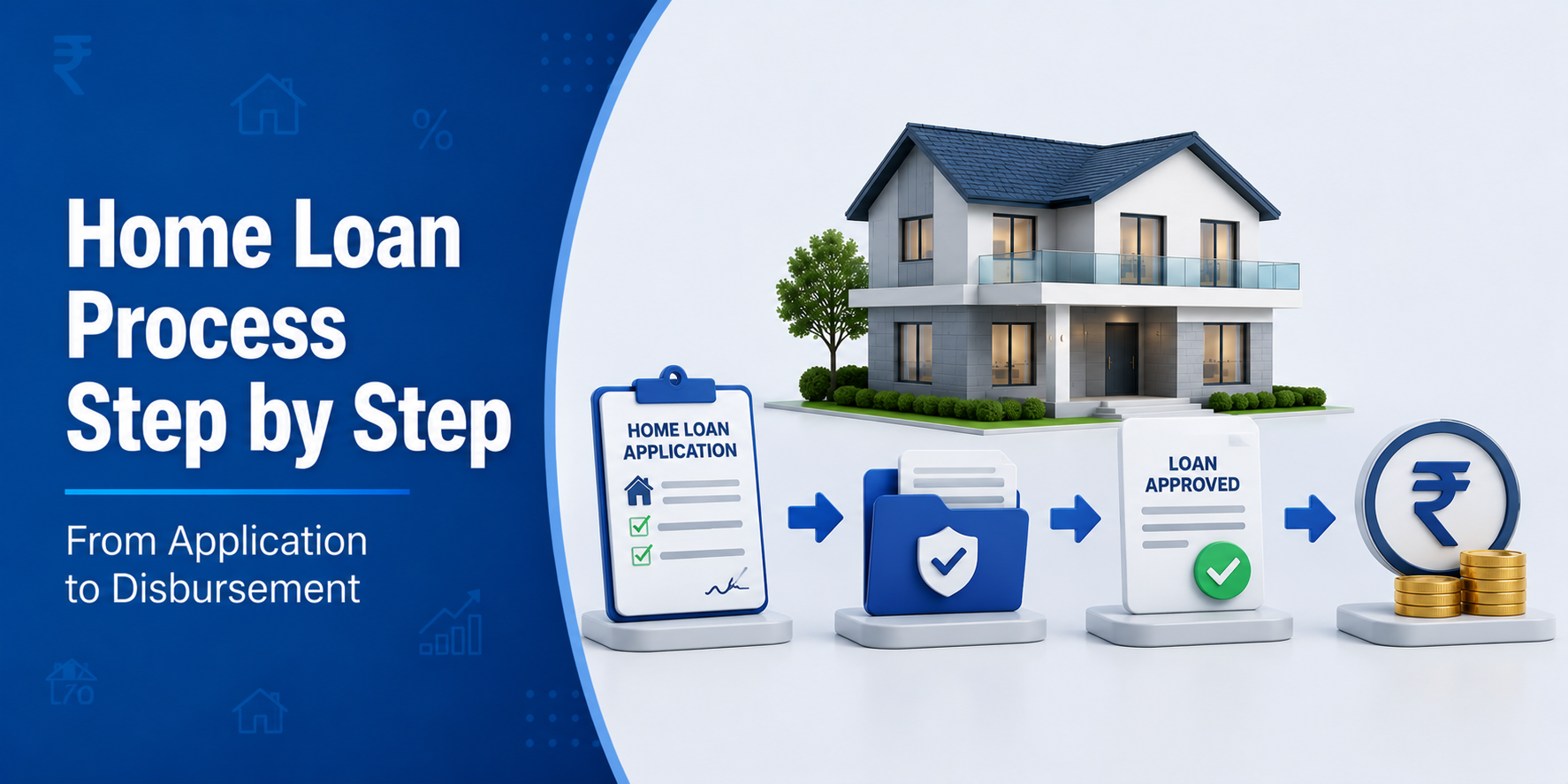
Getting a home loan involves six key stages: application submission, document verification, property evaluation, credit assessment, loan sanction, and final disbursement. The entire process typically takes 7 to 30 days depending on your lender and how quickly you submit documents. With the right preparation and a lender who has a streamlined process, approvals can happen in as little as 48 hours.
What Actually Happens After You Apply for a Home Loan?
Most first-time homebuyers submit an application and then wait — without knowing what’s happening on the other side. That uncertainty is frustrating, especially when you’ve already made commitments on a property.
The home loan process step by step isn’t complicated, but it does involve multiple departments at the lender’s end — and each stage has its own timeline. Understanding each phase helps you follow up smartly, avoid unnecessary delays, and stay in control.
Here’s the complete breakdown.
Stage 1: Loan Application and Initial Submission
The process starts when you fill out the loan application form — either online or at a branch. At this stage, you provide basic details: your income, employment type, the property you want to buy, and the loan amount you’re seeking.
Along with the form, you submit your initial documents. These typically include your identity and address proof, income documents (salary slips or ITR filings), and bank statements from the last three to six months. For salaried borrowers, this list is fairly standard. For self-employed applicants, lenders may ask for business financials as well.
Once your application is submitted, the lender assigns it to a case officer and the formal review begins.
Stage 2: Document Verification
This is where your paperwork gets examined closely. The lender’s team checks that all documents are authentic, complete, and consistent. They’ll verify your employment, cross-check the income figures you’ve declared, and confirm your KYC (Know Your Customer) details.
If anything is missing or unclear, they’ll come back to you with a list of additional requirements. This back-and-forth is one of the most common reasons timelines stretch — so submitting complete documents the first time matters more than most borrowers realise.
According to RBI guidelines on KYC norms, lenders are required to complete customer identification before processing credit applications. This means no stage can be skipped.
Stage 3: Credit Assessment and CIBIL Score Check
Simultaneously, the lender pulls your credit report. Your CIBIL score — which measures your repayment history across all loans and credit cards — plays a central role here.
A score above 700 is generally considered good by most lenders. Scores above 750 unlock better interest rates and faster processing. If your score is below 650, lenders may reject the application or ask for a co-applicant with a stronger profile.
The credit team also evaluates your FOIR (Fixed Obligation to Income Ratio). FOIR refers to the percentage of your monthly income already committed to existing EMIs. Most lenders prefer a FOIR below 50% — meaning less than half your income goes toward existing debt.
This stage is largely automated with modern lenders, which means it can happen within hours rather than days.
Stage 4: Property Valuation and Legal Check
Once your financial profile clears, the lender turns its attention to the property itself. Two parallel checks happen here.
First, a technical valuation. A certified evaluator visits the site (or reviews approved drawings for under-construction properties) to assess the market value. The lender will finance up to 75–90% of this value, depending on your loan amount — this is called the Loan-to-Value ratio, or LTV.
Second, a legal verification. The lender’s legal team reviews the property title, sale deed, encumbrance certificate, approvals from local authorities, and any pending dues. For under-construction properties, they also check that the project is registered under RERA — a mandatory protection for homebuyers.
This stage can take anywhere from 3 to 10 days depending on the complexity of the title chain and the lender’s speed of empanelled vendors.
Stage 5: Loan Sanction
After the credit check and property verification both come back clean, the lender issues a formal sanction letter. This is one of the most important documents in the entire home loan journey.
The sanction letter details the approved loan amount, interest rate (fixed or floating), loan tenure, EMI amount, and any special conditions attached. Read it carefully before signing.
At this point, you may need to pay a processing fee — usually 0.5% to 2% of the loan amount. Some lenders charge this upfront with the application; others collect it at sanction.
The sanction is typically valid for three to six months, giving you time to finalise the property transaction.
Stage 6: Loan Agreement and Disbursement
The final stage is where the money actually moves. Once you’ve accepted the sanction terms, you sign the loan agreement — a legally binding document that outlines all terms and your repayment obligations.
For ready-to-move properties, disbursement usually happens in a single tranche directly to the seller’s account on registration day. For under-construction homes, disbursement is linked to construction progress — you receive the amount in stages as each floor or phase is completed, as per the builder’s demand letters.
After disbursement, your EMI begins. For construction-linked disbursements, you pay only pre-EMI interest on the disbursed amount until the full loan is out.
How Long Does the Home Loan Process Take Overall?
Here’s a realistic timeline:
| Stage | Typical Duration |
|---|---|
| Application and document collection | 1–3 days |
| Document verification | 2–5 days |
| Credit assessment | Same day to 2 days |
| Property valuation and legal check | 3–10 days |
| Sanction | 1–3 days |
| Agreement signing and disbursement | 2–5 days |
| Total | 7–28 days |
With a lender that has invested in digital processing and an in-house legal and technical team, this timeline can compress dramatically. At HomeFirst, eligible home loan applications can be sanctioned in as little as 48 hours from complete document submission to sanction letter, helping homebuyers move faster with greater certainty.
If you’re comparing lenders, ask them directly: how many days from complete document submission to sanction? That’s the only number that matters.
What Can You Do to Keep the Process Moving?
The single biggest thing in your control is document readiness. Delays almost always trace back to incomplete submissions, mismatched details, or missing property documents.
Before you apply, gather your income proofs, bank statements, address proof, PAN and Aadhaar, and all property documents. Learn more about the documents you need for faster approval to avoid unnecessary back-and-forth.
Responding quickly to lender queries also cuts days off the timeline. When they ask for something, treat it as urgent.
Is the Home Loan Process Different for Under-Construction vs Ready Properties?
Yes, in one important way. For ready-to-move properties, everything — sanction and disbursement — happens before or at the time of registration. For under-construction homes, sanction happens before registration, but disbursement is staged over months as construction progresses.
The sanction process itself is similar for both. The legal check differs in that under-construction projects require RERA registration verification and builder approval checks, which can add a few days.
FAQs: Home Loan Process Step by Step
Q1. Can I apply for a home loan before choosing a property?
Yes. You can apply for a pre-approved or in-principle sanction based on your financial profile. This gives you a clear budget and makes you a serious buyer when negotiating. The property verification happens after you finalise the home.
Q2. What is the difference between sanction and disbursement?
Sanction is the lender’s approval of your loan — they’ve agreed in principle to lend you the money. Disbursement is when the money is actually transferred to the seller. Both are separate events and can happen days or weeks apart.
Q3. Can a home loan be approved in 48 hours?
Yes, with some lenders — particularly those with digital workflows and in-house verification teams. Eligibility, credit check, and document review can all be completed within 24–48 hours if your documents are in order. Property verification is a separate step that may take longer.
Q4. What documents are needed for the home loan process?
For salaried borrowers: PAN, Aadhaar, salary slips (last 3 months), Form 16 or ITR, and bank statements (6 months). For self-employed: ITR for 2–3 years, business financials, and bank statements. Property documents are required separately.
Q5. Does the lender charge a fee even if the loan is rejected?
This varies. Some lenders refund the processing fee on rejection; others don’t. Always ask about this upfront before paying. Read the fee terms in the application form.