RBI Guidelines for Home Loans — What Every Borrower in India Should Know
Anurag Sodani • June 16, 2026
Summary
The Reserve Bank of India sets the rules that govern how banks and financial institutions lend for housing. Key guidelines cover how much you can borrow (LTV ratio), interest rate benchmarking, prepayment charges, maximum loan tenure, and your rights when you close a loan. Recent updates have made home loans more borrower-friendly — including zero prepayment charges on floating rate loans and a mandatory 30-day window for lenders to return your original property documents after closure.
Why RBI Guidelines Matter to You as a Home Loan Borrower
Most people think RBI guidelines are technical fine print meant for banks. They’re not. These rules directly shape what you can borrow, what you pay, and what rights you have throughout your loan journey.
If your lender charges you a fee they shouldn’t, holds your property documents after you’ve repaid, or refuses to explain a rate hike — there’s an RBI rule they may be violating. Knowing these guidelines isn’t just useful. It’s your first line of protection.
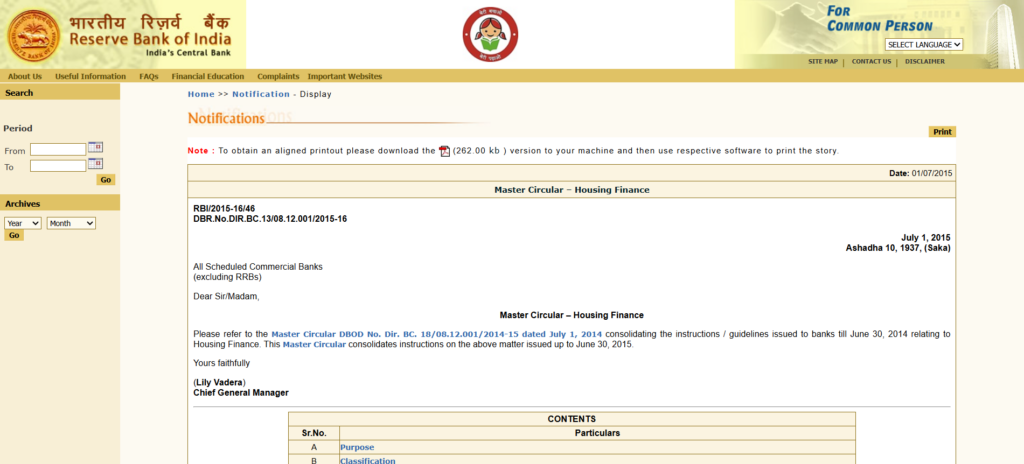
Here’s what you actually need to know.
1. How Much Can You Borrow? The LTV Ratio Rules
The Loan-to-Value (LTV) ratio is the percentage of the property’s value that a lender can finance. The Reserve Bank of India has set these limits for banks:
- Properties valued up to ₹30 lakh — maximum LTV of 90%
- Properties valued between ₹30 lakh and ₹75 lakh — maximum LTV of 80%
- Properties valued above ₹75 lakh — maximum LTV of 75%
What this means practically: if you’re buying a home worth ₹50 lakh, the maximum loan you can get from a bank is ₹40 lakh (80%). The remaining ₹10 lakh is your down payment.
One important point that often catches borrowers off guard — stamp duty, registration charges, and other documentation costs are not included in the property value when calculating LTV. They come out of your pocket separately. The only exception is if the property costs less than ₹10 lakh, where lenders may include these costs in the LTV calculation.
2. Interest Rates: How the Repo Rate Affects Your EMI
The RBI doesn’t set your home loan interest rate directly. What it does is control the repo rate — the rate at which it lends to banks. Banks then set their lending rates based on this benchmark.
In April 2025, the RBI cut the repo rate by 25 basis points, bringing it to 6.00% — the second consecutive cut of the year. When the repo rate falls, banks linked to it pass on the benefit to floating rate borrowers in the form of lower EMIs or reduced tenure.
If your loan is on a floating rate (which most are), your EMI will move up or down when the repo rate changes. Importantly, RBI guidelines require that whenever rates rise and the tenure or EMI increases, lenders must ensure there is no negative amortisation — meaning your interest cannot be silently added to the principal and carried forward. Every EMI must cover at least the interest due.
3. No Prepayment Charges on Floating Rate Loans
This is one of the most borrower-friendly rules the RBI has put in place. If your home loan is on a floating interest rate, your lender cannot charge you a prepayment penalty — whether you’re making a partial payment or closing the loan entirely. This applies to individual borrowers.
For fixed-rate loans, prepayment charges are capped at 3% of the outstanding principal — reduced from the earlier 5%.
This matters because prepayment significantly reduces your total interest outgo. Many borrowers used to hesitate about paying off their loans early, worrying about fees eating into their savings. That concern is gone for floating rate borrowers.
4. Maximum Loan Tenure: 30 Years
RBI guidelines allow lenders to extend home loans for a maximum of 30 years. A longer tenure lowers your monthly EMI but increases the total interest you pay over the life of the loan. Most borrowers choose between 15 and 25 years depending on their income and comfort with EMI load.
5. Your Right to Get Your Documents Back
This is a rule many borrowers don’t know about until they need it.
When you fully repay your home loan and close the account, the lender is required to return all your original property documents within 30 days. If they fail to do this on time, they must pay you a compensation of ₹5,000 for every day of delay. This came into effect from December 2023.
If your documents are lost or damaged by the lender, they are obligated to assist you in obtaining certified copies — and the compensation timeline in such cases extends to 60 days before the daily penalty kicks in.
6. Fair Practices Code and Borrower Protection
The RBI mandates that all banks follow a Fair Practices Code (FPC). This means lenders must:
- Explain all loan terms clearly before you sign
- Not insert hidden charges into your agreement
- Not harass borrowers during recovery
- Provide a proper sanction letter that outlines all key terms
- Not force you to buy insurance products as a condition of loan approval
Insurance may be offered alongside a home loan, but it cannot be made mandatory. If a lender is pressuring you into buying a specific insurance plan as a condition for loan approval, that violates RBI guidelines.
7. Credit Reporting: Updated Every 15 Days
Effective January 2025, lenders must update your credit information with credit bureaus every 15 days, replacing the earlier monthly cycle. This means your credit score reflects your repayment behaviour much more quickly — useful if you’re actively improving your score before applying for a loan or top-up.
8. Stamp Duty and Registration Are Not Part of the Loan
A common misconception is that stamp duty and registration costs can be financed as part of the home loan. They cannot. The RBI has directed banks not to include these costs when calculating the LTV ratio or the loan amount — except for properties below ₹10 lakh. Budget for these costs separately. In most states, stamp duty ranges from 3% to 8% of the property value.
Who Does the RBI Regulate for Home Loans?
The RBI governs home loans extended by scheduled commercial banks, regional rural banks, small finance banks, and — since 2019 — Housing Finance Companies (HFCs) as well. Prior to 2019, HFCs were regulated by the National Housing Bank (NHB). Regulation of HFCs was transferred to the RBI through an amendment to the National Housing Bank Act, bringing all housing lenders under one regulatory umbrella.
This consolidation means the rules above apply whether your loan is from a bank like SBI or HDFC Bank, or from a dedicated housing finance company. The borrower protections are uniform.
FAQs: RBI Guidelines for Home Loans
Q1. Does the RBI set home loan interest rates?
No. The RBI sets the repo rate, which banks use as a benchmark. Individual lenders set their own interest rates above this benchmark. Floating rate loans move with the repo rate; fixed rate loans don’t.
Q2. What is the maximum LTV ratio for a home loan in India?
Up to 90% for properties worth up to ₹30 lakh, 80% for ₹30–75 lakh, and 75% for properties above ₹75 lakh.
Q3. Can my lender charge me for prepaying my floating rate home loan?
No. The RBI prohibits prepayment penalties on floating rate home loans for individual borrowers.
Q4. What happens if my lender doesn’t return my documents after loan closure?
The lender must return your original property documents within 30 days of loan closure. If they delay, they owe you ₹5,000 per day as compensation.
Q5. Are Housing Finance Companies also covered under RBI guidelines?
Yes. Since 2019, regulation of HFCs was transferred from the National Housing Bank to the RBI. All HFC home loans are now governed by the same RBI framework.
Q6. Can stamp duty and registration charges be included in my home loan?
Generally no. The RBI directs lenders not to include these costs in the LTV calculation. Only for properties under ₹10 lakh can these be added.
Q7. What is the maximum home loan tenure allowed?
Up to 30 years, as per RBI guidelines.
Q8. How often is my credit report updated now?
Effective January 2025, lenders must report credit information to bureaus every 15 days — a change from the earlier monthly cycle.