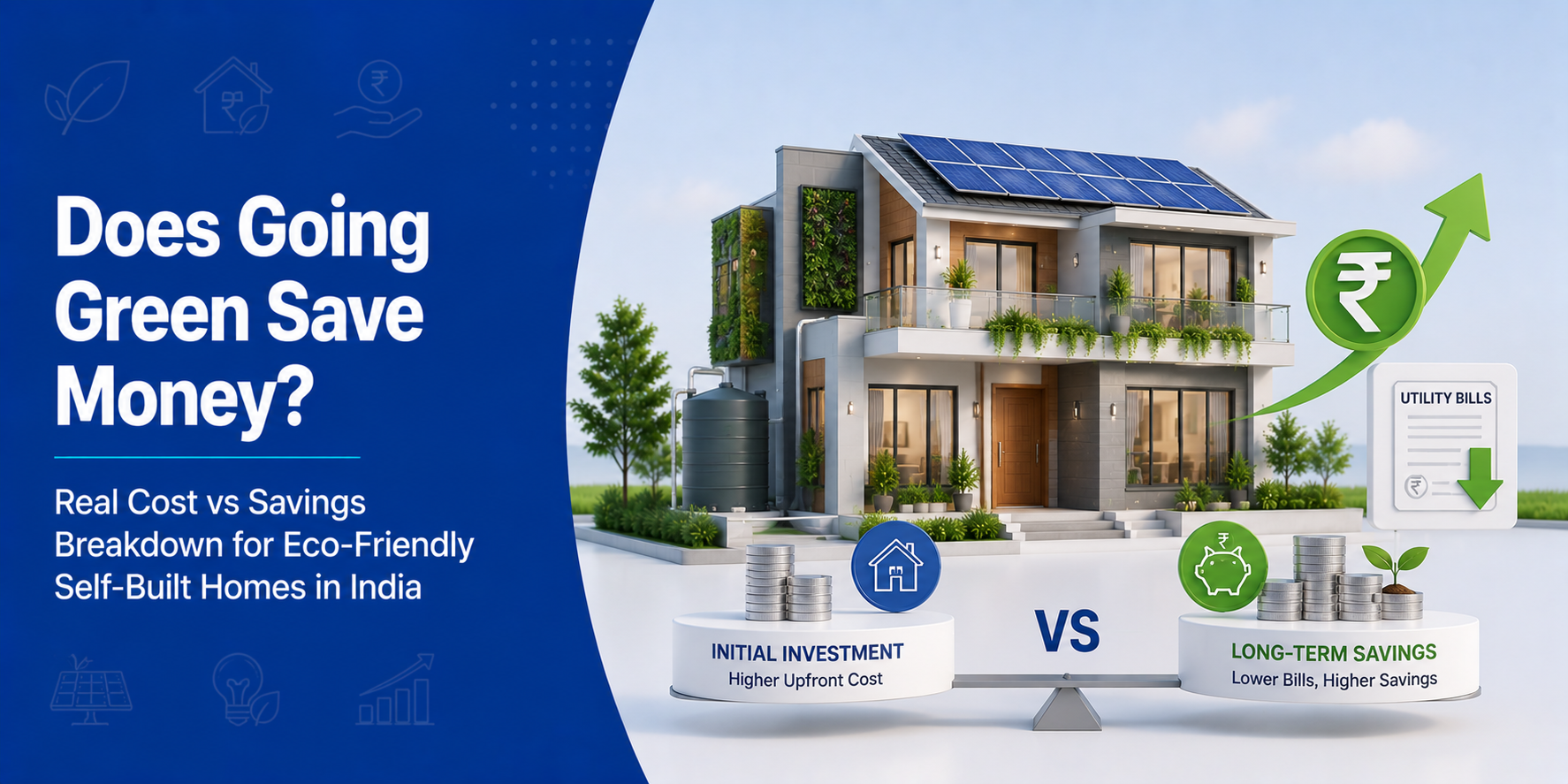
Does Going Green Save Money? Real Cost vs Savings Breakdown for Eco-Friendly Self-Built Homes in India
Anurag Sodani • June 15, 2026

Picture this: You are standing on an empty plot of land with a blueprint in hand and a strict budget in your mind. Every truckload of sand, every bag of cement, and every bundle of steel reinforcement bars matters. When you are building your first home, your primary focus is how much it costs to build and how to avoid being buried under construction bills. In the middle of balancing your budget, someone mentions building an “eco-friendly” or green home. Your immediate reaction is probably a skeptical shake of the head. For a long time, green buildings have been marketed as a luxury tier—complete with expensive rooftop solar grids, imported automated fixtures, and premium price tags.
But here is the real truth: true green building is not about adding expensive gadgets after the house is built. It is about frugal engineering during the construction phase.
By making smart, intentional design choices before the first shovel hits the dirt, you can actually lower your initial construction expenses, minimize structural material waste, and permanently shield your household from rising utility bills.
The Construction Cost Myth: Does “Green” Mean Expensive?
The fear of high upfront costs keeps many independent home builders from exploring sustainable options. It is a common misconception that choosing eco-friendly options automatically adds a 20% to 30% premium to a contractor’s estimate.
In reality, sustainable construction relies on a simple principle: resource efficiency. When you design a house to be efficient, you use fewer raw materials. And when you use fewer materials, your overall construction bill drops.
For the average Indian family building an independent home, going green does not require complex international technology. It requires returning to sensible, localized building practices updated with modern, affordable alternatives.
Real Material Breakdown: Smart Swaps That Reduce Construction Costs
Let’s look at the actual numbers and material choices. By substituting standard, resource-heavy building products with sustainable alternatives, you can optimize your upfront budget.
1. Traditional Red Bricks vs. AAC (Autoclaved Aerated Concrete) Blocks
Clay mining for traditional red bricks destroys fertile topsoil and demands massive energy during kiln firing. From a constructor’s perspective, red bricks are also heavy, inconsistent in shape, and slow to lay.
- The Green Swap: AAC Blocks or Fly-Ash Bricks. AAC blocks are made using fly ash (an industrial waste byproduct), cement, lime, and water.
- The Construction Cost Savings:
- Reduced Steel & Concrete: AAC blocks are roughly one-third the weight of traditional clay bricks. This massive reduction in structural weight means your foundation, columns, and beams do not need to carry a massive dead load. Consequently, your structural engineer can safely reduce the amount of TMT steel and concrete required for the building framework.
- Mortar Savings: Because AAC blocks are much larger and possess precise geometric edges, you need up to 60% less cement-sand mortar to join them together.
- Labor Efficiency: Their large size allows masonry teams to build walls up to three times faster, significantly cutting down on daily labor wages.
2. Standard Concrete Roofs vs. Reflective Cool Roof Finishes
A standard concrete roof absorbs intense solar radiation all day, turning your upper floor into an oven by late afternoon. The traditional fix is to install high-tonnage air conditioning units or run ceiling fans on maximum speed all night, driving up electrical setup costs.
- The Green Swap: High-albedo reflective cool roof paints or broken ceramic tile masonry (China Mosaic) over the roof slab.
- The Construction Cost Savings: Applying a reflective coating or using broken white ceramic tile waste is an incredibly inexpensive process. It reflects over 80% of solar heat. By preventing heat from penetrating the concrete slab, you can often downsize your household appliances—saving money on buying high-tonnage ACs—and eliminate the need for expensive false ceiling insulation layouts.
3. Blind Layout Design vs. Climate-Responsive Orientation
Many builders copy generic home designs without analyzing how sunlight and wind move across their specific plot. This results in windows that face the harsh afternoon sun, requiring heavy curtains, tinted glass, and artificial cooling.
- The Green Swap: Passive architectural design. This simply means orienting your longest walls north and south to minimize direct sun exposure, and planning windows to encourage natural cross-ventilation.
- The Construction Cost Savings: This costs exactly zero rupees. By optimizing your window placement and extending your chajjas (concrete sunshades) slightly further, you use basic physics to keep the home bright and cool. You save money immediately on window treatments, heavy glass, and excess wiring for heavy cooling appliances.
The Savings Blueprint: Monthly Utility Reductions
Once construction wraps up and you move into your new home, the green design features transition from lowering construction costs to lowering operational bills. In partnership with the International Finance Corporation (IFC), frameworks show that a properly planned sustainable home improves resource efficiency by at least 20%.
Let’s look at how those savings accumulate month after month:
The Water Equation
Traditional plumbing fixtures discharge far more water than necessary. Furthermore, as groundwater tables deplete across semi-urban India, buying water from private tankers has become a major, unpredictable monthly expense.
Low-Flow Aerators: Installing inexpensive aerators on taps and showers mixes air with water. It maintains strong water pressure while cutting actual water consumption by 30% to 40%.
The Energy Equation
Between traditional incandescent bulbs, inefficient fans, and poor natural light, electricity bills can quickly strain a household budget.
- BLDC Fans & LED Layouts: Planning your internal electrical layout around energy-efficient LED fixtures and Brushless DC (BLDC) fans cuts cooling and lighting energy needs significantly..
Cost vs. Savings Matrix for Independent Home Builders
To see how these choices interact, look at this quick reference comparison for an average 1,000 sq. ft. independent home build:
| Construction Component | Conventional Choice | Eco-Friendly Smart Alternative | Upfront Construction Cost Impact | Monthly Household Budget Impact |
| Wall Masonry | Traditional Red Clay Bricks | AAC / Fly-Ash Blocks | Lower (Saves on framework steel, cement mortar, and labor days) | Lower Bills (Excellent thermal insulation keeps interiors cool) |
| Roof Treatment | Plain Concrete / Screed Concrete | Reflective Cool Roof Coating | Minimal Cost (Inexpensive paint or tile-waste application) | Lower Bills (Reduces indoor temperatures by 3–5°C; cuts AC run-time) |
| Plumbing Setup | High-Flow Standard Fixtures | Low-Flow Taps & Showers with Aerators | Price Parity (Aerators add negligible cost to standard plumbing) | Lower Bills (Reduces monthly water consumption by up to 40%) |
| Ventilation & Light | Arbitrary Window Placement | Strategic Orientation & Deep Chajjas | Zero Added Cost (Requires only smart planning on the blueprint) | Lower Bills (Maximizes free daylight; reduces daytime fan usage) |
Democratizing Sustainable Construction: The HomeFirst Approach
At Home First Finance Company (HomeFirst), the focus is entirely on making affordable homeownership a practical reality for every segment of society. For families within the Economically Weaker Sections (EWS) and Low-Income Groups (LIG), every rupee saved during construction is a rupee that secures their financial health.
HomeFirst firmly believes that affordability and sustainability can coexist. This isn’t a theoretical goal; it is a measurable program. As highlighted in HomeFirst’s FY26 Sustainability Report, the company’s dedicated Green Homes initiative, run in partnership with the IFC, has scaled significantly to support self-builders and affordable housing buyers:
“For us, environmental responsibility extends beyond our offices. Housing is a long-lived asset, and decisions made at the time of construction influence energy and resource use for decades. Our Green Homes initiative, in partnership with IFC, reflects our belief that affordability and sustainability can coexist… As of March 2026, we have certified 450 Green Homes with a portfolio of ₹55 Cr AUM, from 120 homes in March 2025.”
With 83% of HomeFirst’s loan book maintaining a ticket size below ₹25 lakhs and over 59% of loans supporting EWS and LIG customers, HomeFirst is rewriting the rules of green building. This initiative proves that eco-friendly homes are not premium novelties; they are essential, cost-saving solutions for everyday builders.
As real home builders note, the benefits are clear from day one. In the words of HomeFirst customer Rohit Kumar Sahu:
“A green home is much better than a regular home. It has helped me save a lot more during and after construction.”
By focusing on smart materials and accessible construction plans, home builders minimize waste, keep initial construction costs low, and establish lower operational expenses for the future.
Summary Checklist for Green Home Builders
If you are preparing to build your home and want to keep construction costs low while locking in long-term utility savings, keep this checklist on your radar:
- Choose AAC or Fly-Ash Blocks: Use lighter blocks and adjust structural design to reduce material requirements and costs.
- Plan for Sun and Wind: Position windows for natural ventilation while minimizing direct heat from sunlight.
- Install Reflective Roofing: Use cool-roof coatings or reflective layers to lower future cooling expenses.
- Use Low-Flow Plumbing: Install aerators early to reduce water consumption and utility bills.
- Partner with the Right Lender: Choose a housing finance expert who supports affordable, sustainable home construction.
Building a house is a milestone achievement. By choosing an efficient, eco-friendly approach, you can cut construction waste, protect your budget, and build a comfortable, cost-effective home for the long run.
Have questions about financing your independent green home construction without overstretching your budget? Connect with us.