Khatauni: Meaning, Download Process & Home Loan Documents
Anurag Sodani • June 29, 2026
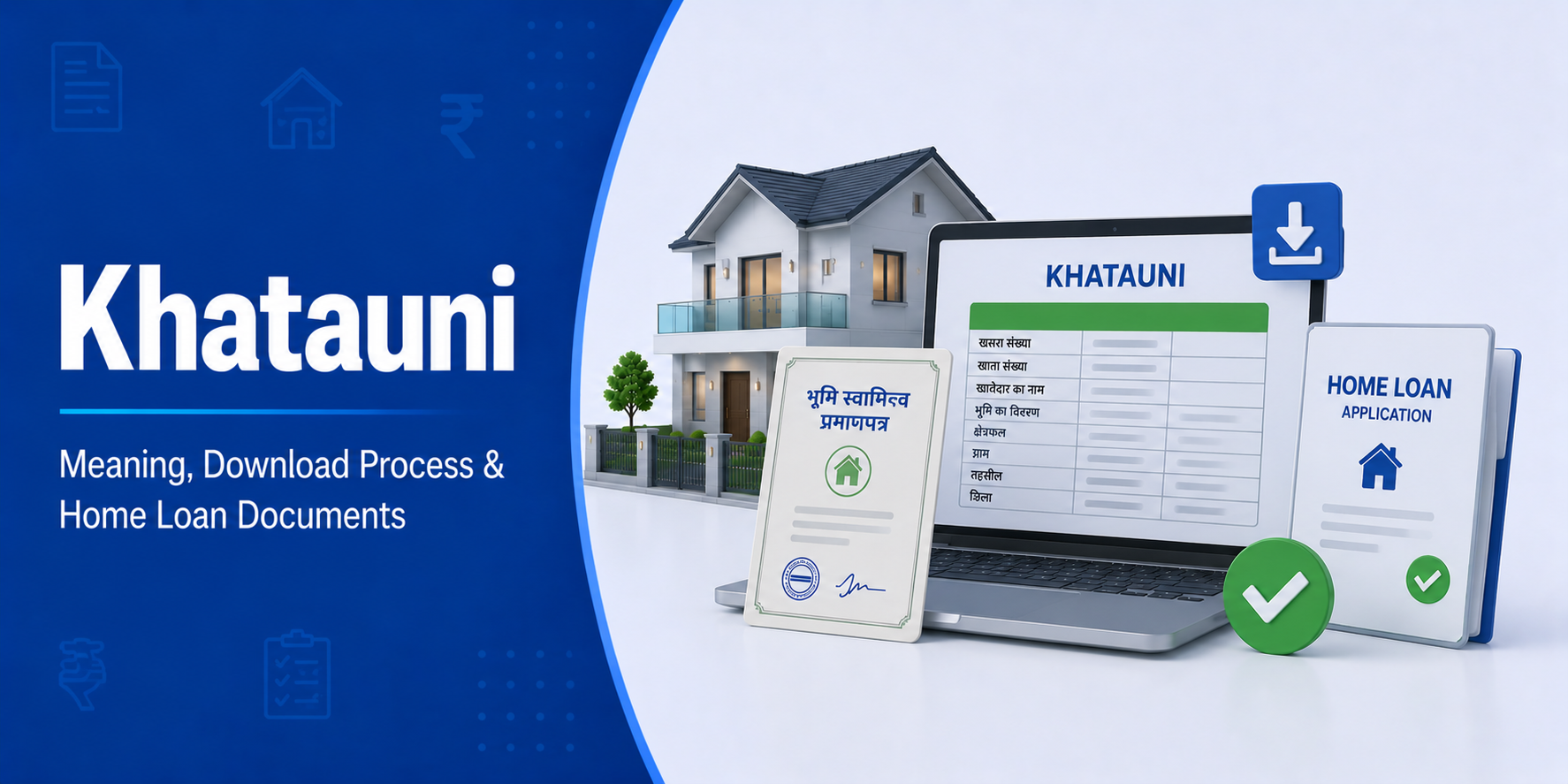

Anyone dealing with land ownership in Uttar Pradesh — or in several other northern Indian states — will encounter one document repeatedly during property transactions and home loan applications: the Khatauni UP Bhulekh extract. Yet many property buyers and first-time homeowners are unsure what Khatauni actually contains, how it differs from the Khasra, and exactly what role it plays when a bank asks for it. This guide answers all of those questions directly and practically.
What is Khatauni?
Khatauni is the Record of Rights (RoR) for land in Uttar Pradesh and several other northern and central Indian states (MP, Bihar, Uttarakhand, Chhattisgarh). It is the official account-level land ownership document maintained by the state Revenue Department.
The word comes from “Khata” — meaning account — and the Khatauni is essentially a consolidated account statement of all land a specific owner holds within a village. A single Khatauni entry can cover multiple plots.
What it contains:
- Khata number (unique account identifier for the owner in that village)
- Name of the Khatedar (landowner)
- Khasra numbers of all plots owned by that Khatedar
- Area of each plot (in Hectare or Bigha)
- Land classification (agricultural / residential / barren / forest)
- Nature of possession (owned / tenanted / mortgaged / disputed)
- Any encumbrances, court orders, or rights attached to the land
- Co-ownership details (if the land has multiple owners)
What is the Difference Between Khasra and Khatauni?
This distinction is fundamental and frequently misunderstood.
| Feature | Khasra | Khatauni |
|---|---|---|
| What it is | Plot-level identifier | Account-level ownership record |
| What it records | Details of one specific plot (area, crop, classification) | All plots owned by one Khatedar in a village |
| Scope | One plot | One owner (may cover multiple plots) |
| Used for | Identifying a specific piece of land | Verifying overall land ownership of a person |
| Also called | Gata number (in some areas) | Record of Rights (RoR) |
| Relation | Every Khasra number appears in a Khatauni | One Khatauni contains multiple Khasra numbers |
Practical example: If Ramesh owns three plots in a village — Khasra numbers 101, 107, and 215 — his Khatauni will list all three plots under one Khata number. Each Khasra (101, 107, 215) is a separate plot-level record; the Khatauni is the combined ownership account.
What is UP Bhulekh and How Does It Relate to Khatauni?
UP Bhulekh is the official digital land records portal of the Uttar Pradesh government, available at upbhulekh.gov.in. “Bhulekh” means land record in Hindi (Bhu = land, Lekh = writing/record).
UP Bhulekh digitised all its records across UP’s districts and made them publicly accessible online — one of the largest land record digitisation exercises in India. Through UP Bhulekh, you can:
- View and download Nakal (certified and view copies)
- Search by Khata number, Khasra number, or owner name
- Access Khasra map details
- Check mutation (Dakhil Kharij) status
- Find Khasra Girdawari (seasonal crop inspection records)
How to Download Khatauni Nakal from UP Bhulekh (Step-by-Step)
- Visit upbhulekh.gov.in
- Click on “Khatauni (Adhikar Abhilekh) Ki Nakal Dekhen” — this means “View Khatauni Record of Rights Copy”
- Enter the Captcha code shown on screen
- Select your District → Tehsil → Village (Gram)
- Search using one of these options:
- Khata Sankhya (Khata number)
- Khasra Sankhya (Khasra/plot number)
- Khatedar Ka Naam (Owner’s name)
- Select the correct entry from the results
- The Khatauni appears on screen — click “Print / Download” to save as PDF
Note: The UP Bhulekh online copy is a view extract. For a certified Khatauni Nakal with official stamp — required for legal proceedings and home loan final disbursement — visit your Tehsildar’s office or Rajya Sahkari Bank citizen service centre.
Nakal — Certified vs Non-Certified
| Type | Where to Get | Legal Use | Fee |
|---|---|---|---|
| Non-certified (view copy) | UP Bhulekh online — free | Preliminary verification, bank pre-approval | Free |
| Certified Nakal | Tehsildar’s office or CSC | Court filings, home loan disbursement, formal legal purposes | Nominal government fee |
| Digitally signed Nakal | UP Bhulekh (e-signed option) | Accepted for most official purposes | Nominal fee via portal |
What is Mutation (Dakhil Kharij) in UP?
Mutation is the process of updating the Khatauni to reflect a change in ownership. In Uttar Pradesh, mutation is called Dakhil Kharij and is filed with the Sub-Divisional Magistrate (SDM) or Tehsildar.
Mutation must be applied for separately after property registration. Without mutation, the revenue records still show the previous owner — which creates problems for home loans and future sales.
How to apply for mutation in UP:
- File an application at the SDM / Tehsildar’s office with the registered sale deed, Aadhaar, and previous Khatauni copy
- The Lekhpal (Patwari equivalent) conducts a field inquiry
- The SDM / Tehsildar approves or rejects the mutation
- The approved mutation is entered into the Khatauni in the next update cycle
Mutation status can be tracked on UP Bhulekh under the mutation tracking section.
Khasra Khatauni in Home Loan Verification
When you apply for a home loan on a property in Uttar Pradesh, the lender’s legal team pulls the Khasra records as a core part of their property due diligence. Here is what they look for:
Ownership confirmation:
The Khatedar’s name in the Khatauni must match the seller. If it does not, mutation is incomplete — the lender will not proceed until the revenue record reflects the correct current owner.
Land classification:
The Khatauni specifies whether land is agricultural (Krishi Bhoomi) or otherwise. Agricultural land in UP cannot be mortgaged for a standard home loan without first obtaining an agricultural to residential land use conversion. Most lenders check this explicitly.
Encumbrances:
If the Khatauni shows an existing mortgage (Rehn) or court attachment on the Khasra numbers being purchased, the lender will flag this as a title risk.
Area verification:
Lenders compare the area in the Khatauni with the area in the sale deed and the approved building plan to detect discrepancies.
Before applying, ensure your Khatauni reflects the correct owner through completed mutation, the land is appropriately classified, and there are no encumbrances. Use a home loan eligibility calculator to estimate your borrowing capacity alongside this verification.
FAQs on Khatauni and UP Bhulekh
Q: What is Khatauni?
Khatauni is the Record of Rights (RoR) for land in Uttar Pradesh and other northern Indian states. It is an account-level document that records all land plots owned by a specific person in a village, along with ownership details, encumbrances, and rights.
Q: What is the difference between Khasra and Khatauni?
Khasra is the plot-level identifier — it records details of one specific piece of land. Khatauni is the account-level ownership record — it groups all plots owned by one person under a single Khata number. One Khatauni can contain multiple Khasra numbers.
Q: Is the UP Bhulekh Khatauni legally valid for a home loan?
The online view copy is accepted for preliminary bank verification. For final home loan disbursement, most lenders require a certified Nakal from the Tehsildar’s office or a digitally signed copy from the UP Bhulekh portal.
Q: What is Dakhil Kharij in UP?
Dakhil Kharij is the mutation process in Uttar Pradesh — the formal update of the Khatauni to reflect a new owner after purchase, inheritance, or gift. You must file the mutation application with the SDM or Tehsildar before the authorities can update the new owner’s name in the revenue records.
Q: Can I check Khatauni by owner name on UP Bhulekh?
Yes. On UP Bhulekh, after selecting your district, tehsil, and village, choose “Khatedar Ka Naam” (owner’s name) as your search option. Enter the name to view all Khatauni entries under that owner in that village.
Conclusion
Khatauni UP Bhulekh records give property buyers and homeowners a clear, reliable view of land ownership and encumbrances in Uttar Pradesh. Understanding what Khatauni is, how it differs from Khasra, and how to download it correctly can save significant time during property purchase and home loan processing. Always verify that mutation is complete and land classification is appropriate before finalising any transaction. For more resources on property documents and housing finance, explore the HomeFirst Finance blog.