5 Simple Green Home Upgrades That Cut Your Bills — And Get You a Green Cashback
Anurag Sodani • June 5, 2026

Picture this. Your electricity bill comes down every month. Your water usage drops by nearly half. And then one day, a lump sum amount lands directly in your bank account — because you built your home the right way.
This is not a fantasy. This is what green home upgrades in India can actually do for you, when you pair them with the right home loan.
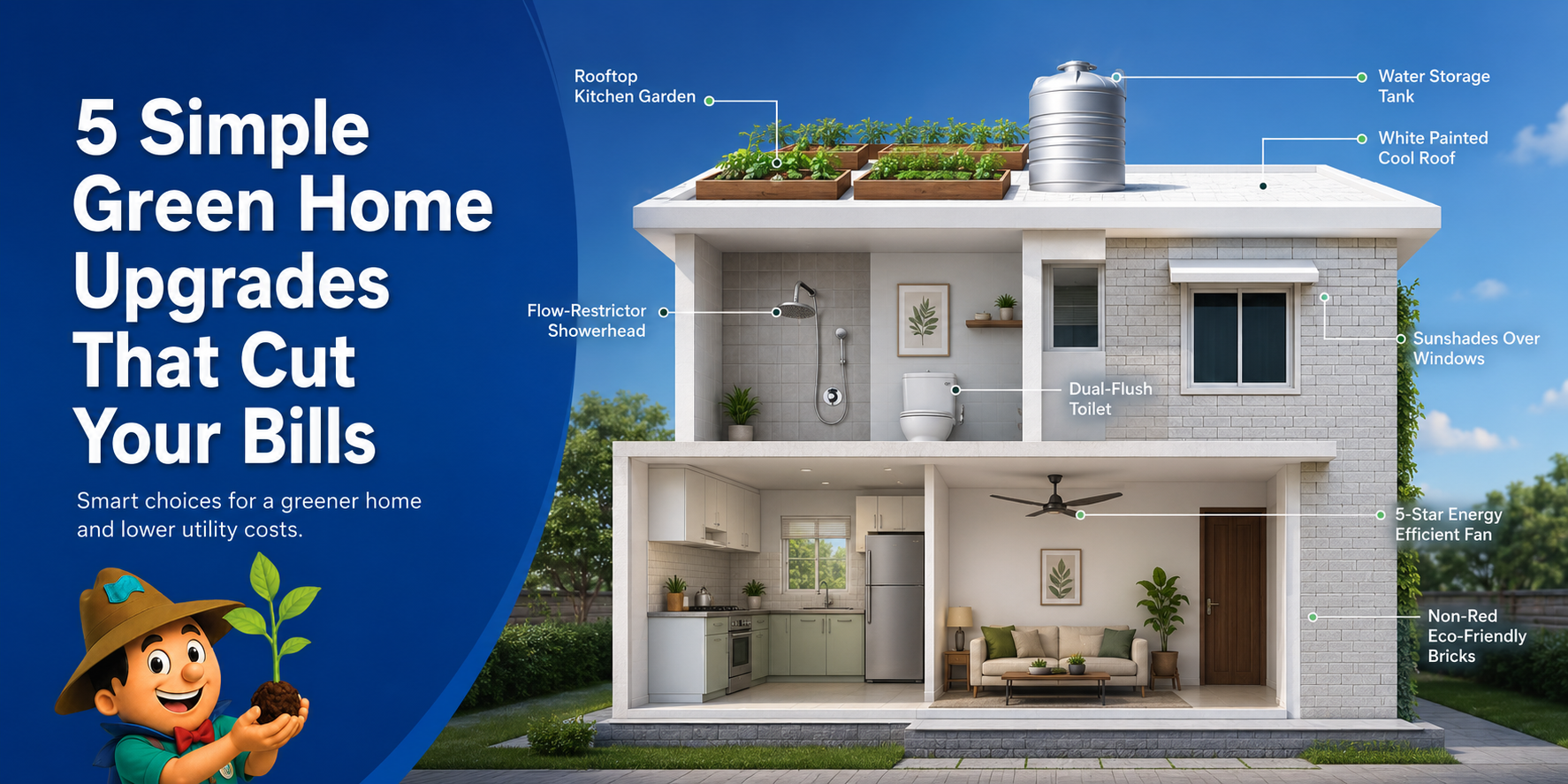
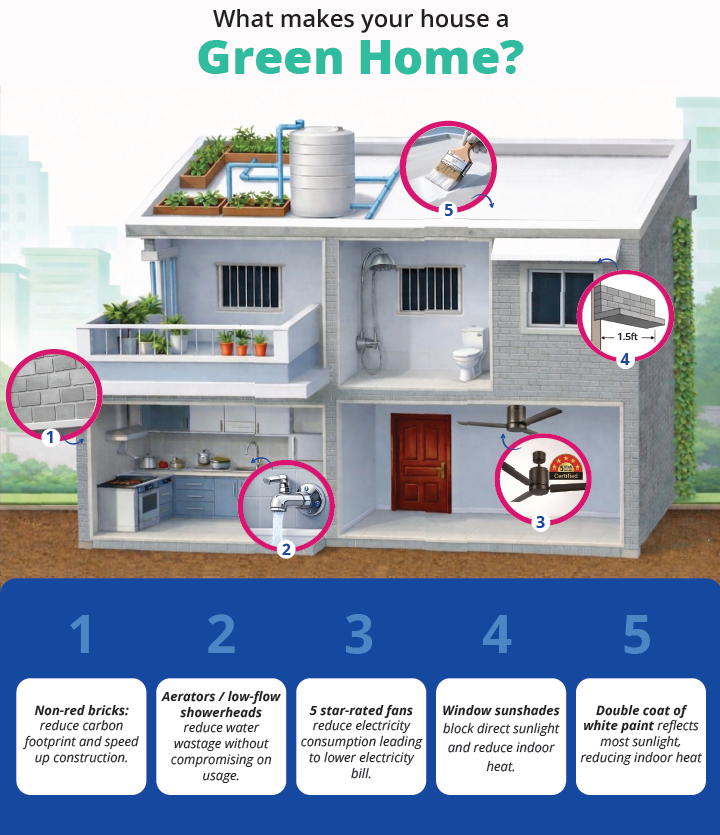
HomeFirst Finance has now guided 500 homebuyers to build certified green homes in the self-build affordable housing space. Every single one of these homes follows five simple features — no complicated technology, no massive extra budget. Just five smart choices made during construction or renovation.
This blog walks you through all five. It also explains the two layers of savings you unlock — one that shows up on your monthly bills, and one that shows up directly in your bank account.
The Two Savings Nobody Tells You About
Before we get into the upgrades, let us understand why they matter financially — not just environmentally.
Saving Layer 1: Lower Monthly Utility Bills
A green home is 20% carbon footprint efficient uses 20% less electricity and 20% less water than a conventional home. Therefore, every month your bills are lower. This is not a one-time benefit. It compounds over 5, 10, 20 years of living in your home. For a typical Indian household, the combined savings on electricity and water can run into thousands of rupees every year.
Saving Layer 2: Green Cashback from HomeFirst
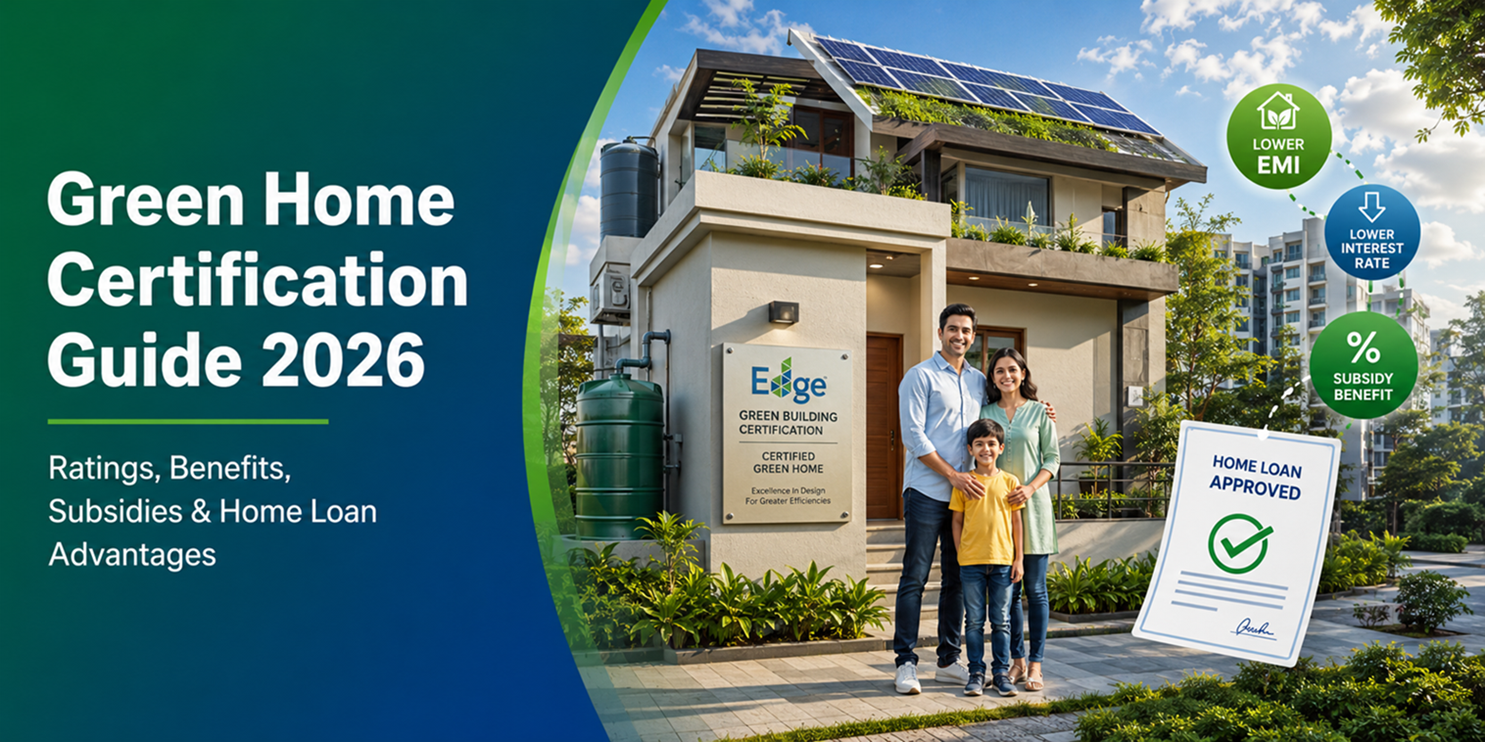
Here is the one most people do not know about. If you take a home loan from HomeFirst and build an EDGE certified green home, you become eligible for a green cashback — 2.4% of your loan amount gets credited directly into your bank account.
This is actual money, deposited to you. For example, on a ₹25 lakh loan, you get 2.4% Green Cashback i.e ₹60,000 that is a significant lump sum. On top of this, if you are income-eligible under PMAY(U)- 2.0 ISS, you also get an additional ₹1.8 Lacs subsidy.
Two subsidy benefits for a single Home Loan. And life long savings on utility bills. That is what a HomeFirst green home does for you.
Now, let us look at the five upgrades that make all of this possible.
Upgrade 1: Non-Red Bricks — The Foundation of a Greener Home
Most Indian homes are built with red bricks. They are everywhere, and for a long time, no one questioned them. However, the problem is real — manufacturing red bricks involves burning clay at high temperatures, which releases significant carbon emissions. Additionally, good agricultural topsoil is excavated to make them, which damages the land.
Non-red bricks — fly ash bricks, AAC (Autoclaved Aerated Concrete) blocks, or compressed earth blocks — solve both problems at scale. In fact most of the commercial construction in India has moved to Non Red Bricks!
Why Non-Red Bricks Make Sense
Fly ash bricks are made from industrial waste (fly ash from thermal power plants). Therefore, using them actually recycles waste that would otherwise sit in landfills. AAC blocks are lighter, which means faster construction and less load on the structure. Compressed earth blocks use locally available soil with minimal processing.
Beyond the environmental benefit, non-red bricks also have practical advantages. AAC blocks, for instance, have better thermal insulation than red bricks. As a result, your home stays cooler in summer and warmer in winter — which means less AC usage and lower bills.
The cost difference between red bricks and fly ash bricks is minimal. In many markets, fly ash bricks are actually cheaper because they are a byproduct of existing industrial processes.
This upgrade does not cost extra. It just requires asking your contractor for the right material.
Upgrade 2: Aerators and Low-Flow Showerheads — Save Water Without Even Noticing
Here is a question. If you could cut your home’s water consumption by nearly half — without changing how you bathe, cook, or clean — would you? Of course you would.
That is exactly what tap aerators and low-flow showerheads do.
How Aerators Work
A tap aerator is a small mesh device that screws onto your existing tap in about two minutes. It mixes air into the water stream, so the flow feels the same but the actual volume of water used drops from 8–12 litres per minute to around 2–4 litres per minute. No plumber needed. No change to your tap fitting.
A low-flow showerhead works on the same principle. A standard showerhead uses 10–15 litres per minute. A low-flow version brings that to 5–8 litres per minute.
What the Numbers Look Like
For a family of four showering daily and using taps throughout the day, these two upgrades together can save 80,000–1,00,000 litres of water a year. In cities where water charges are rising — Bengaluru, Chennai, Pune, Hyderabad — that is real money saved every month, month after month.
The total cost of aerators for an entire home is typically under ₹1,500. Low-flow showerheads cost ₹600–₹2,500. The payback period is measured in weeks, not years.
Additionally, less water heated means your geyser runs less, which further reduces your electricity bill. So this upgrade saves both water and electricity at the same time.
Upgrade 3: 5-Star Rated Fans — The Easiest Electricity Saving in Your Home
Indian summers are getting hotter every year… Ceiling fans run 24×7 in most Indian homes for through most of the year. However, most people never think about how much electricity their fan actually consumes. They should.
A standard old ceiling fan with an induction motor consumes 70–75 watts. A BEE 5-star rated or BLDC (Brushless DC) fan consumes 25–35 watts. That is a saving of roughly 40–50 watts per fan, per hour.
Let the Numbers Do the Talking
Take a home with five ceiling fans. Each runs 8 hours a day, 300 days a year. Switching all five from standard to BLDC fans saves approximately:
- 40W saved × 8 hrs × 300 days × 5 fans = 480 units of electricity per year
- At ₹7 per unit, that is ₹3,360 saved every year, just from fans
Most BLDC fans are priced between ₹1,800 and ₹3,000. Therefore, the fans pay for themselves within two years. After that, it is pure saving — for the next 10–15 years of the fan’s life.
Brands like Atomberg, Orient, Havells, and Crompton all offer good 5-star BLDC options. Since January 2023, BEE star labelling for ceiling fans is mandatory in India — so look for the 5-star label before you buy.
Additionally, BLDC fans are quieter, have better speed control, and often come with remote or app controls. So you get a better product and a lower bill.
Upgrade 4: Window Sunshades of 1.5 Feet — The Upgrade Builders Always Skip
Walk past any old Indian home built before the 1990s and look up. You will notice something that modern builders have quietly stopped including — wide, overhanging window sunshades. Chajjas, as they are called locally.
There is a reason traditional architecture included them. They work.
Why 1.5 Feet Matters
A window sunshade of at least 1.5 feet blocks direct sunlight from entering your rooms during the hottest parts of the day — particularly in the afternoon when the sun is at its harshest angle. Because direct sunlight does not hit your floor and walls, your indoor temperature stays significantly lower.
The result is that your fan or AC does not have to work as hard. Rooms feel cooler naturally. And your electricity bill reflects that.
This upgrade is most effective on west-facing and south-facing windows, where afternoon sun hits hardest. However, adding sunshades on all windows makes a noticeable difference to your home’s overall thermal comfort.
The cost is minimal when built during construction — it is essentially an extension of your RCC slab. Retrofitting is possible but more expensive. Therefore, if you are building now, include 1.5-foot sunshades from the start. It is one of those decisions you will thank yourself for every single summer.
Additionally, sunshades also double as rain protection. They keep rainwater from entering through open windows during monsoon — which means less water damage and less maintenance over time.
Upgrade 5: Double Coat of White Roof Paint — The Simplest Cooling System You Have Never Tried
Your roof is the single largest surface exposed to the sun in your home. On a peak summer afternoon in most Indian cities, a dark or unpainted concrete terrace can reach 60–65°C. That heat pushes straight into your top-floor rooms. Your AC or fan fights it all day. Your electricity bill shows it at the end of the month.
A double coat of white cool roof paint changes this entirely.
What White Roof Paint Actually Does
White cool roof coatings reflect a large portion of solar radiation instead of absorbing it. Research on cool roofs across Indian climatic zones shows that the average energy saving on cooling costs ranges from 10–20%, and indoor temperatures drop by around 3–5°C.
For a home running a ceiling fan or a 1-ton AC, that temperature drop is genuinely noticeable. Rooms stay cooler from the morning, allowing fans to operate at lower speeds. As a result, the AC reaches the desired temperature faster and cycles off sooner.
The coating also typically doubles as waterproofing — so you save on monsoon repairs too.
What It Costs and When It Pays Back
A double coat of cool roof paint on a 1,000 sq ft terrace costs approximately ₹10,000–₹20,000 depending on the brand and product. Most good quality coatings last 5–7 years.
If your electricity bill falls by even ₹2,500–₹4,000 a summer as a result, this upgrade pays for itself within three to five years. After that, every summer is pure saving.
This is the upgrade that surprises people the most. It looks like paint. It feels like paint. But it performs like a passive cooling system that runs without any electricity, every single day.
How a Green Home Loan Helps You Fund These Upgrades
Here is the thing about these five upgrades. Individually, most of them are affordable. The bigger investments — non-red bricks, sunshades, and cool roof paint — are best built into your construction budget from the start.
And if you are taking a home loan to build your house anyway, you are already in the right position to fund all of this.
HomeFirst Finance offers a home loan product specifically for green home builders. The process is simple: build your home with these green features, get your EDGE green home certification, and HomeFirst deposits the 2.4% green cashback directly into your bank account. It is not a rate adjustment on paper. It is real money, transferred to you.
On a ₹20 lakh loan, that cashback is a significant amount. Additionally, if you are income-eligible under PMAY-U 2.0, you also receive the government’s interest subsidy of up to ₹1.8 lakhs separately. Both benefits can work together for the same loan.
The green home product for individual self built home are not available with most hfc and traditional bank. HomeFirst is one of the very few — and their customers in the affordable housing segment are exactly the people who benefit most from every rupee saved.
Explore HomeFirst’s home loan options here and read more about why going green is also a financial decision.
Your Green Home Checklist Before You Begin
If you are planning to build or renovate and want to qualify for green certification and the HomeFirst cashback, here is what to keep in mind:
- Use non-red bricks (fly ash, AAC blocks, or compressed earth)
- Install tap aerators, low-flow showerhead and dual flush in toilet
- Fit 5-star or BLDC fans in every room
- Build 1.5-foot window sunshades on all windows
- Apply a double coat of white cool roof paint on your terrace
These five features are exactly what the EDGE Green Homes certification evaluates for individual residential homes. And they are also what HomeFirst’s green home loan is built around. If you want to understand what a green home means more broadly before you start, this beginner’s guide is a good read.
FAQs
Q: What is the green cashback from HomeFirst and how do I get it?
Once your home is built with the five green features and gets EDGE green home certification, HomeFirst deposits the 2.4% subsidy amount directly into your bank account. It is not a paper adjustment — it is actual money transferred to you. Your HomeFirst loan executive can walk you through the process from the start.
Q: Do I need to do all five upgrades to qualify for the green cashback?
The green home certification from EDGE is based on meeting a minimum points threshold across multiple green features. Having all five of these — non-red bricks, aerators, 5-star fans, sunshades, and white roof paint — puts you in a strong position to qualify. Speak with HomeFirst before you begin construction so they can guide you on exactly what is required for your home type and size.
Q: Can I get both the PMAY subsidy and HomeFirst’s green cashback on the same loan?
Yes, if you are income-eligible under PMAY-U 2.0 (EWS, LIG, or MIG category) and you also build a certified green home through HomeFirst, both benefits apply. The PMAY interest subsidy comes from the Government of India based on your income. The green cashback comes from HomeFirst based on your home’s green certification. They are independent of each other.
More FAQs
Q: How much will I realistically save on monthly bills with all five upgrades done?
It depends on your city, usage, and home size. However, a typical household with all five green features can expect meaningful reductions in both electricity (from BLDC fans, lower AC load due to sunshades and white roof) and water bills (from aerators and low-flow showerheads). Many HomeFirst customers report combined annual savings of several thousand rupees — and that saving continues every year for the life of the home.
Q: Are non-red bricks actually available in Tier 2 and Tier 3 cities?
Yes. Fly ash bricks are now widely available across most Indian cities and towns because they are manufactured near thermal power plants, which are spread across the country. AAC blocks are also increasingly available outside metros. Your local building material supplier will likely stock them — and in many cases, they cost the same or less than red bricks.
Conclusion
A green home is not a luxury. It is not a concept for premium buyers in big cities. It is five simple decisions — made at the right time, during construction — that save you money every month for decades, and put a cashback amount directly in your bank account through HomeFirst.
The five green home upgrades in India that HomeFirst has built its entire programme around are non-red bricks, aerators and low-flow showerheads, 5-star BLDC fans, 1.5-foot window sunshades, and a double coat of white roof paint. All of them are available. And together, they qualify your home for EDGE green certification and HomeFirst’s green cashback.
Start with the right loan. Build the right home. Save from day one — and get paid for it when certification comes through.
Disclaimer: The information shared in this article — including interest rates, EMI calculations, subsidy amounts, property prices, eligibility criteria, and market trends — is meant for general information only. The data is based on publicly available sources, working knowledge, and industry trends available at the time of publication. All figures, examples, and estimates are indicative in nature and should not be treated as official commitments, guarantees, or offers from Home First Finance.