IGBC, GRIHA, EDGE — Green Building Certifications Explained for Indian Self-Constructed Homes
Anurag Sodani • June 15, 2026

Urbanization in India is accelerating at an unprecedented pace. Millions of families are transitioning from renters to first-time homeowners, looking to build or buy spaces that promise stability, comfort, and long-term value. However, modern homeownership is no longer just about choosing the right location or a beautiful layout. It is increasingly about sustainability.
According to data from the United Nations Environment Programme (UNEP), buildings consume roughly 40% of global energy and generate nearly a third of greenhouse gas emissions. As climate change shifts weather patterns across India—bringing harsher summers and unpredictable monsoons—the long-term viability of a home depends on how resource-efficient it is.
For an average Indian home buyer, the phrase “green home” often sounds like an expensive buzzword or a luxury reserved only for premium high-rise townships. This is a common misconception. Thanks to localized frameworks and dedicated financing systems, affordable green housing is scaling rapidly across the country.
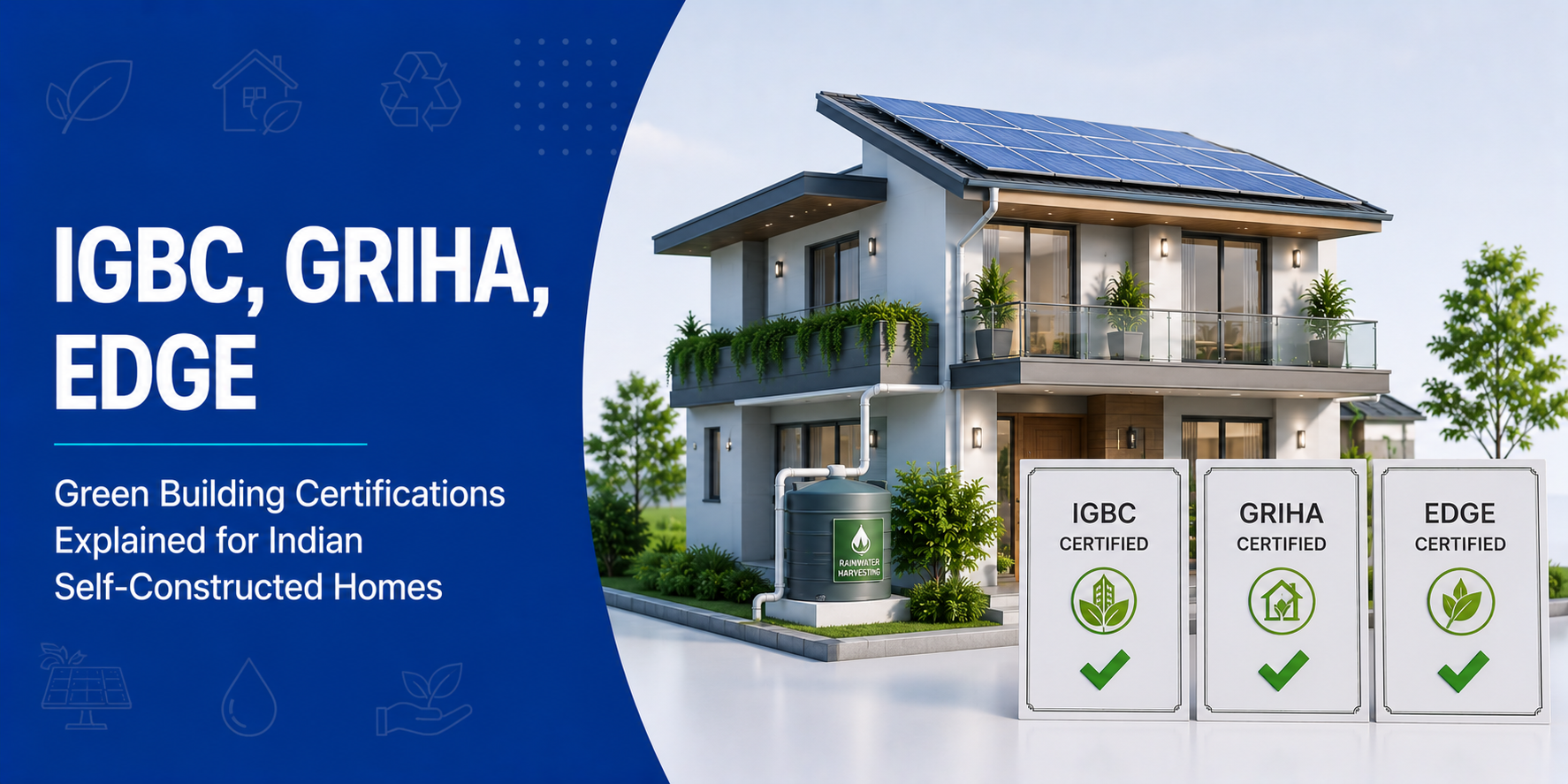
To help consumers navigate this landscape, independent organizations evaluate and grade structures based on their eco-friendliness, water efficiency, and energy savings. In India, the three most prominent frameworks are IGBC, GRIHA, and EDGE. Understanding these green building certifications empowers buyers to make choices that protect both the environment and their monthly household budgets.
Why Green Building Certifications Matter to You
A building cannot simply be labeled “green” because it has a few plants on the balcony or uses energy-efficient light bulbs. A certified green home must undergo rigorous third-party testing, documentation, and operational audits. The resulting certificate is the only verifiable proof that a home reduces environmental impact.
For Indian home buyers, purchasing a certified green property offers major advantages:
- Substantial Utility Savings: Certified green homes are built to reduce energy consumption by at least 20% and water usage by up to 30% to 40%. This translates directly into lower monthly electricity and water bills for the lifetime of the asset.
- Enhanced Health and Indoor Quality: These frameworks maximize natural cross-ventilation, and optimize daylighting. This reduces indoor air pollution and provides superior thermal comfort, lowering reliance on artificial air conditioning.
- Lower Construction Costs: Sustainable construction can also reduce upfront building costs through smarter material choices and efficient design practices. The use of resource-efficient materials and optimized construction methods can lower material consumption, reduce wastage, and improve thermal performance—making green homes more cost-effective to build without compromising quality.
- Financial Incentives: Municipal bodies in many Indian cities offer property tax rebates or faster construction approvals for certified green buildings. Furthermore, forward-thinking lenders like Home First Finance Company (HomeFirst) offer direct financial incentives, such as specialized subsidies and cashback programs, for buyers building or investing in verified sustainable homes.
Unpacking the Big Three: IGBC vs. GRIHA vs. EDGE
While all three certification bodies share the ultimate goal of resource conservation, their methodologies, origins, and specific focal areas differ. Let’s look closely at each system from an Indian buyer’s perspective.
1. IGBC (Indian Green Building Council)
Launched in 2001 by the Confederation of Indian Industry (CII), the IGBC is India’s premier homegrown green certification body. It focuses heavily on commercial and residential real estate, adapting international sustainability ideas to fit the Indian context.
The IGBC Green Homes rating system was developed specifically for the residential sector. It evaluates both individual homes and multi-dwelling residential complexes. The framework grades structures based on local availability of materials, site planning, water conservation, and structural innovation.
- Rating Thresholds (out of 100 points):
- Certified (50–59 points): Reflects best practices in construction.
- Silver (60–69 points): Reflects outstanding environmental performance.
- Gold (70–79 points): Achieves national excellence in green features.
- Platinum (80–100 points): Represents global leadership in sustainability.
Because it is tailored to Indian construction practices and material supply chains, IGBC is highly popular among private real estate developers across India’s Tier-1 and Tier-2 cities.
2. GRIHA (Green Rating for Integrated Habitat Assessment)
GRIHA is India’s official national rating tool for green buildings. Developed by The Energy and Resources Institute (TERI) alongside the Ministry of New and Renewable Energy (MNRE), GRIHA was formally adopted by the Government of India in 2007.
GRIHA is an indigenous system designed to evaluate buildings across India’s diverse climatic zones—from the hot-dry regions of Rajasthan to the warm-humid coastal areas. It evaluates a building across its entire lifecycle, focusing closely on minimizing resource disruption during the construction phase itself. This includes regulating soil erosion, ensuring safety and sanitation for construction workers, and mandating the use of industrial waste materials like fly-ash bricks and slag cement.
For smaller residential properties, the council offers a simplified variant called SVAGRIHA (Simple Versatile Affordable GRIHA), making it highly accessible for smaller developments.
- Rating Thresholds (evaluated on a 1-to-5 star scale):
- 1 Star: 25–40 points
- 2 Stars: 41–55 points
- 3 Stars: 56–70 points
- 4 Stars: 71–85 points
- 5 Stars: 86 or more points
GRIHA is heavily utilized in public infrastructure, government residential quarters, and civic-led affordable housing schemes, often tied to municipal property tax incentives.
3. EDGE (Excellence in Design for Greater Efficiencies)
EDGE is a globally recognized green building certification system developed by the International Finance Corporation (IFC), a member of the World Bank Group. Designed specifically to make sustainable construction practical and affordable, EDGE helps homeowners, developers, and builders identify the most cost-effective ways to reduce energy consumption, water usage, and the embodied carbon of building materials. It is currently used in more than 140 countries and is certified in most markets by GBCI.
Unlike more documentation-intensive rating systems, EDGE focuses on measurable resource efficiency. To qualify for certification, a project must demonstrate a minimum 20% reduction in energy use, water use, and embodied carbon in materials compared to a conventional local building baseline. This makes EDGE particularly attractive for self-constructed homes, affordable housing projects, and developers seeking a straightforward pathway to green certification.
EDGE Certification Levels:
- EDGE Certified: Minimum 20% savings in energy, water, and embodied carbon
- EDGE Advanced: At least 40% energy savings
- EDGE Zero Carbon: EDGE Advanced requirements plus 100% renewable energy or carbon offsets for operational emissions
Because of its simplicity, affordability, and strong alignment with green financing programs, EDGE has gained significant traction across emerging markets, including India. It is especially well-suited for individual homeowners and residential projects seeking verified sustainability performance without the complexity associated with some other international certification frameworks. EDGE certification can also improve eligibility for green home loans and sustainability-linked incentives offered by select financial institutions.
Direct Comparison Matrix for Indian Home Buyers
| Parameter | IGBC (Indian Green Building Council) | GRIHA (National Rating System) | EDGE (Excellence in Design for Greater Efficiencies) |
| Origin | Private/Industrial (CII) | Government backed (TERI / MNRE) | International (IFC) |
| Primary Focus | Indian real estate market, localized material usage, design ease. | Indigenous climate zone compatibility, lifecycle impact, construction waste. | Global standards, advanced tech integration, carbon footprint reduction. |
| Grading System | Certified, Silver, Gold, Platinum | 1-Star to 5-Star Rating | Certified, Advanced, Zero Carbon |
| Affordable Housing Focus | High (Dedicated residential protocols) | Very High (Features SVAGRIHA & affordable housing alignments) | Moderate (Mainly active in large townships but provided by HomeFirst for affordable segment) |
Democratizing Sustainability: HomeFirst’s Green Housing Mission
A common barrier for low- and middle-income home buyers is the assumption that integrating green features requires massive upfront capital. However, through simple design choices—like using ACC blocks, applying reflective cool-roof paint, setting up low-flow water aerators, a home can meet high sustainability benchmarks at minimal cost.
Recognizing that affordability and environmental care must coexist, HomeFirst has stepped up to bridge the financing gap for green homes across India.
Driving Real Impact
HomeFirst deeply embeds sustainability into its corporate strategy and daily operations. According to their FY26 Sustainability Report, HomeFirst’s dedicated Green Homes initiative, launched in partnership with IFC, has expanded significantly.
The numbers highlight this steady growth:
- In March 2025, HomeFirst had certified 120 Green Homes.
- By March 2026, that number climbed to 450 certified Green Homes, a portfolio of ₹55Cr in Assets–Under–Management (AUM).
With over 59% of its total loan book serving the Economically Weaker Sections (EWS) and Low-Income Groups (LIG), HomeFirst is actively proving that sustainable living is achievable for every segment of Indian society.
Financial Rewards for Sustainable Building
For individuals constructing their own independent homes or buying units in small-scale developments, HomeFirst provides a direct financial incentive: a 2.4% green home loan subsidy on loan amounts up to ₹25 lakhs.
When a buyer partners with HomeFirst, a dedicated loan executive helps identify the most practical green features to implement based on the home’s size and location. Once an authorized rating body verifies the completed construction, HomeFirst deposits the 2.4% subsidy directly into the customer’s loan account. This meaningful financial return helps offset initial construction costs while ensuring long-term utility savings.
A Buyer’s Checklist for Choosing or Building a Green Home
If you are currently in the market to buy or construct a home, use this step-by-step approach to navigate green certifications:
- Ask for Certification Proof: If purchasing from a developer, check if the project has an IGBC or EDGE “Pre-Certification” (during the design phase) or a final certificate.
- Review the Grading Level: Look beyond the green label to see the exact rating. A Gold or Platinum IGBC rating, or a 4-to-5 star GRIHA rating, indicates top-tier energy and water management.
- Focus on Practical Independent Elements: If you are building your own home, prioritize high-impact, affordable features:
- Materials: Fly-ash bricks or AAC blocks for superior insulation.
- Water: Rainwater harvesting pits and low-flow plumbing fixtures.
- Energy: 5 Star-rated appliances, BLDC fans, LED lighting, and solar-ready wiring.
- Engage a Green-Friendly Financial Partner: Inform your lender early about your sustainability goals. HomeFirst’s Green Home Loan offers construction guidance and a 2.4% cashback subsidy for eligible homes.
Conclusion: Building a Resilient Future
Choosing a certified green home is an impactful decision for any modern home buyer. Whether certified by IGBC, GRIHA, or EDGE homes reduce emissions, improve health, and lower long-term utility costs
HomeFirst makes sustainable homeownership more accessible through practical green financing solutions and affordable housing support. Investing in a certified green home protects your financial future while contributing to a cleaner, more resilient India.