CERSAI: Full Form, Meaning, Registration Process, Charges & Its Role in Home Loans
Anurag Sodani • June 9, 2026
TL;DR: CERSAI — the Central Registry of Securitisation Asset Reconstruction and Security Interest of India — is a government-backed online registry that records all security interests created on properties during lending. Established under the SARFAESI Act, 2002, CERSAI prevents fraudulent multiple mortgages, protects lenders, and ensures transparency in India’s banking system. It also manages the CKYC registry, housing over 70 crore KYC records.
If you’ve recently applied for a home loan, you’ve probably noticed a small line item called “CERSAI charges” in your loan cost sheet. Most borrowers ignore it. A few ask their lender what it means. Fewer still understand what CERSAI actually does — and why it matters more than the charge itself.
CERSAI is not just a fee. It’s the backbone of fraud prevention in India’s secured lending ecosystem. This guide explains everything — the CERSAI full form, its role in home loans, the registration process, login steps, applicable charges, and its connection to CKYC.
What is CERSAI? Its Role in the Indian Banking and Financial Sector
CERSAI full form is the Central Registry of Securitisation Asset Reconstruction and Security Interest of India. It is a centralised online platform that maintains a comprehensive database of security interests created on movable, immovable, and intangible properties by banks and financial institutions across the country.
Before CERSAI existed, a serious problem plagued India’s lending sector. A borrower could walk into Bank A, pledge their property for a loan, and then approach Banks B and C with the same property as collateral. No central system existed to catch this. Lenders had no way to verify whether an asset was already pledged elsewhere.
CERSAI was created to solve exactly this problem.
CERSAI was established under the Securitisation and Reconstruction of Financial Assets and Enforcement of Security Interest (SARFAESI) Act, 2002, and became operational in 2011, with the objective of creating a unified platform for registering and accessing information on various types of securities.
Today, CERSAI operates as a Government of India company licensed under Section 8 of the Companies Act, 2013. Its headquarters are in New Delhi. The Reserve Bank of India (RBI) plays a supervisory role in CERSAI’s operations, while key shareholders include the Central Government, major public sector banks like SBI and Punjab National Bank, and the National Housing Bank (NHB).
CERSAI has evolved over time to maintain a comprehensive registry covering security interests in immovable, movable, and intangible properties, along with the assignment of receivables. It now also oversees a KYC Registry under the PML Rules 2005, hosting over 70 crore KYC records as of March 31, 2023.
Any bank, NBFC, or housing finance company that creates a security interest on a customer’s property is legally required to register that interest with CERSAI — within 30 days of creation.
Importance and Main Objectives of CERSAI
CERSAI isn’t just a data registry. It’s an active instrument of financial integrity. Understanding its objectives helps you see why it’s mandatory — not optional — for every secured lender in India.
1. Preventing Fraudulent Multiple Mortgages
This is CERSAI’s primary purpose. CERSAI means in banking that every mortgage is recorded centrally. This prevents “double-financing” where one property is used to take multiple loans illegally. Before any lender sanctions a loan against a property, they check the CERSAI database to confirm no prior charge exists on that asset.
2. Centralised Security Interest Registry
CERSAI maintains a single, searchable database covering all security interests registered by banks, NBFCs, and housing finance companies across India. This eliminates fragmentation and gives every lender access to the same verified information.
3. Enhancing Transparency and Accountability
CERSAI is a centralised online platform created by the Reserve Bank of India to maintain records of all types of securities interests created over any type of property, including movable and immovable properties, introduced to prevent fraudulent transactions and provide greater transparency and accountability in the Indian banking and financial sector.
4. Supporting the CKYC Registry
CERSAI also manages India’s Central KYC (CKYC) registry under the Prevention of Money Laundering (PML) Rules, 2005. This means borrowers who complete KYC at one financial institution don’t need to repeat the process with every other institution.
5. Enabling Asset Recovery Under SARFAESI
Failure to register within 30 days can lead to monetary penalties and a loss of recovery rights under the SARFAESI Act. By mandating timely registration, CERSAI ensures that lenders retain full legal standing to enforce their security interest if a borrower defaults.
6. Facilitating Smooth Property Resale
A “clean” CERSAI record — showing the satisfaction of a previous loan — makes it easier for future buyers to secure financing. When a property has no outstanding charges on the CERSAI database, both buyers and their lenders gain confidence in the transaction.
What is a CERSAI Registration Charge?
Here’s where most home loan borrowers have questions. When you take a secured loan — especially a home loan — your lender registers the security interest on the CERSAI official portal. For this registration, CERSAI levies a statutory fee. That fee is what shows up in your loan documentation as the “CERSAI charge.”
CERSAI fees on a house loan are officially known as the “Memorandum of the Deposit of Deed Fee.” It is important to note that CERSAI charges on a home loan must be paid mandatorily, even if the bank has refused to give a loan to the borrower.
CERSAI Charges in India
| Transaction Type | Charges (Excluding GST) |
|---|---|
| CERSAI Search | ₹10 |
| Creation or Modification of Security Interest | ₹50 (up to ₹5 lakh) ₹100 (above ₹5 lakh) |
| Reconstruction or Securitisation of Financial Assets | ₹500 |
| Satisfaction of Security Interest | ₹50 |
| Assignment of Receivables | ₹10 (below ₹5 lakh) ₹100 (₹5 lakh and above) |
CERSAI charges are fees levied by the Central Registry of Securitisation Asset Reconstruction and Security Interest of India (CERSAI) for registering, modifying, searching, or satisfying security interests on assets. These charges help maintain a centralized database of loans, mortgages, and other secured transactions, reducing the risk of fraud and multiple financing against the same asset.
For most home loan borrowers, the relevant charge is the Creation of Security Interest fee, which lenders pay to register the mortgage with CERSAI. Depending on the lender’s policy, this cost may be included in the loan processing charges recovered from the borrower. GST is applicable in addition to the fees mentioned above.
Standard CERSAI Charges on Home Loans
| Loan Amount | CERSAI Registration Charge |
|---|---|
| Up to ₹5 lakhs | ₹50 (plus applicable GST) |
| Above ₹5 lakhs | ₹100 (plus applicable GST) |
| Public Search (by anyone) | ₹10 per search |
These are statutory charges set by the government. They are non-refundable. Additionally, CERSAI charges are non-refundable statutory administrative fees.
Does CERSAI charge differ from bank to bank?
The statutory fee charged by CERSAI itself is fixed and uniform — it does not vary by lender. However, individual lenders may pass on this cost differently in their processing fee structures, or may add administrative handling charges on top. So while the base CERSAI fee is the same for all borrowers with a similar loan amount, the total amount you see on your loan cost sheet can vary slightly depending on how your lender accounts for it.
Who pays the CERSAI charge?
In practice, your bank or housing finance company registers the security interest on your behalf. They then debit the CERSAI charge from your account — usually along with the processing fee at the time of loan disbursement. So while the lender technically files the registration, the borrower ultimately bears the cost.
For home loans and loan against property, this is mandatory. There’s no way to waive it or negotiate it down.
If you’re calculating the total upfront cost of your home loan, use the Home Loan EMI Calculator to get a clear picture of your monthly payments alongside one-time charges.
What is the SARFAESI Act and Why Does It Matter?
You cannot fully understand CERSAI without understanding the law that created it.
The SARFAESI Act — Securitisation and Reconstruction of Financial Assets and Enforcement of Security Interest Act, 2002 — is a landmark piece of legislation in Indian banking. Before this Act, recovering loans from defaulters required lengthy court proceedings. Banks were stuck with mounting NPAs (Non-Performing Assets) with no quick legal recourse.
The SARFAESI Act changed this fundamentally. It gave banks and financial institutions the power to take possession of and sell secured assets without going to court — provided the borrower has defaulted on a loan classified as an NPA.
The SARFAESI Act enables banks and financial institutions to recover loan dues without the court’s intervention in certain cases.
CERSAI was created under Section 20 of this Act specifically to support this framework. By maintaining a central registry of all security interests, CERSAI ensures that lenders have a legally defensible record of their claim on the pledged asset — which is essential if they ever need to invoke SARFAESI proceedings.
Key provisions under SARFAESI relevant to borrowers:
- Lenders can issue a demand notice to a defaulting borrower requiring repayment within 60 days.
- If unpaid, the lender can take symbolic or actual possession of the property.
- The property can then be sold through auction without court intervention.
- CERSAI registration is a prerequisite for a lender to exercise these rights.
For homeowners with Home First Finance home loans or a loan against property, understanding this framework helps you appreciate why timely EMI repayment protects not just your finances but your property rights.
How to Do CERSAI Login
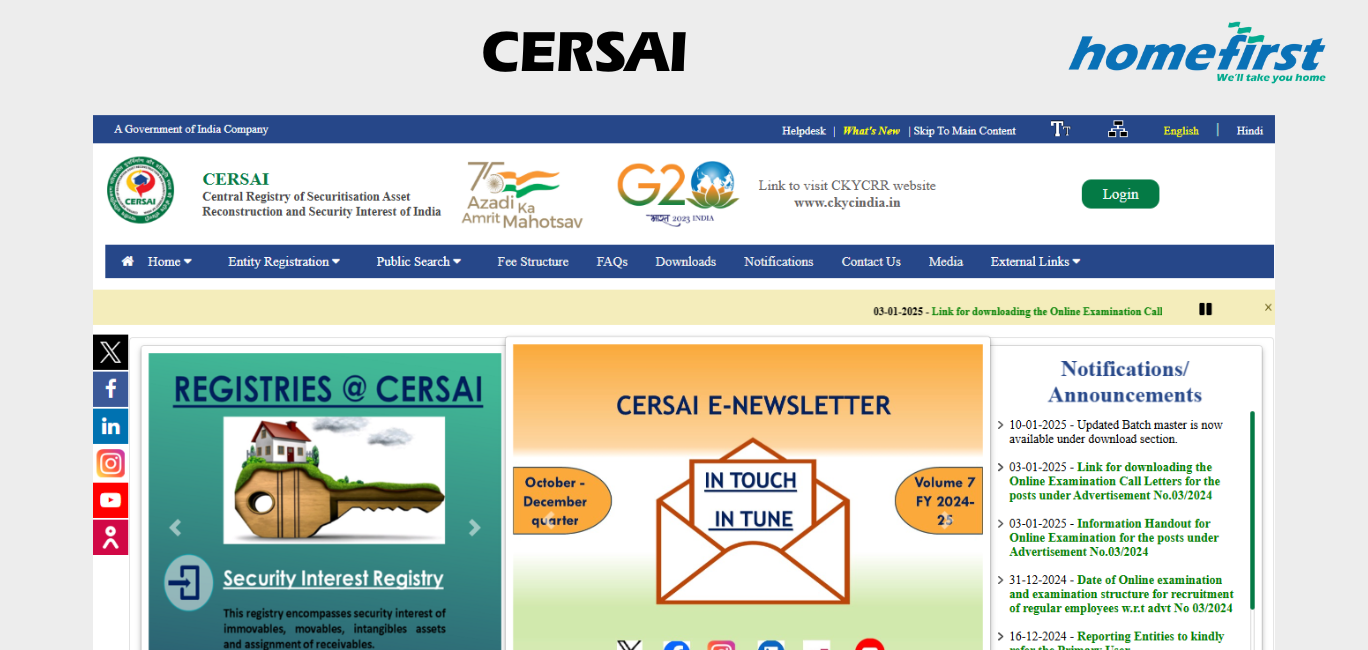
The CERSAI portal is accessible to registered entities — banks, NBFCs, housing finance companies, and their authorised users. Individual borrowers cannot log into the entity portal, but can use the public search feature to check a property’s status.
Here is how CERSAI login works for registered entity users:
Step 1: Go to the official CERSAI website.
Step 2: Click the “Login” button at the top right corner of the homepage.
Step 3: Enter your User ID and Password in the fields provided.
Step 4: Complete the CAPTCHA verification displayed on screen.
Step 5: Click “Login” to proceed to your dashboard.
Step 6: If your entity has DSC (Digital Signature Certificate) enabled, insert your USB token and enter your token PIN when prompted.
Step 7: Once authenticated, you’ll reach your entity dashboard where you can file new security interest registrations, modify existing ones, or search records.
Forgotten credentials can be reset using the “Forgot Password” option on the login screen. If your entity account is inactive or locked due to failed attempts, contact CERSAI’s helpdesk through the official portal for resolution.
How to Apply for Entity Registration on CERSAI
Entity registration on CERSAI is mandatory for all banks, NBFCs, housing finance companies, cooperative banks, and small finance banks that create security interests on customer assets.
Prerequisites for Entity Registration:
- Valid Certificate of Incorporation
- Memorandum and Articles of Association (MoA and AoA)
- Board Resolution authorising the registration
- PAN card of the entity
- A valid Class 3 Digital Signature Certificate (DSC)
- Clean credit history and sound financials
- Registration with the relevant regulatory authority (RBI, NHB, SEBI, etc.)
Step-by-Step Entity Registration Process:
Step 1: Visit the CERSAI official website.
Step 2: Click on “New Entity Registration” on the homepage.
Step 3: Choose the registration mode — security interest registration, CKYC, or both depending on your entity type.
Step 4: Fill in the complete entity details — name, registered address, CIN, PAN, regulatory authority, and authorised signatory details.
Step 5: Upload the required documents — Certificate of Incorporation, MoA, Board Resolution, and the authorised user’s ID proof.
Step 6: Upload your Class 3 Digital Signature Certificate or follow the DSC registration steps at this stage.
Step 7: Enter the CAPTCHA and click “Submit”.
Step 8: Once submitted, CERSAI verifies the application. Upon approval, the entity receives a User ID and password to access the portal.
You can track the progress of your registration application online through the portal after submission.
Importance of CERSAI in Financial Transactions
CERSAI does far more than just record mortgages. Its role in the broader financial ecosystem is substantial and growing.
For Lenders (Banks and NBFCs):
CERSAI gives every lender a real-time window into the encumbrance status of any property being offered as collateral. Before sanctioning a loan, the lender checks the CERSAI database. If the property already has an active charge registered against it, the lender can take an informed decision — and potentially avoid a fraudulent transaction.
CERSAI acts as a central registry maintaining a comprehensive database of security interests created over movable and immovable properties, enabling stakeholders to access critical information swiftly and accurately.
For Borrowers:
CERSAI protects you too. When you repay your loan fully, your lender files a “satisfaction of charge” on the CERSAI portal, confirming that no outstanding claim exists on your property. This is essential before you sell, transfer, or re-mortgage the property.
For Property Buyers:
Before purchasing a second-hand property, a smart buyer always runs a CERSAI search. It confirms whether any existing loan charge remains on the property. Buying a property without checking CERSAI can expose you to the previous owner’s unpaid liabilities.
For the Financial System:
CERSAI builds systemic trust. The existence of a centralised, accessible, and legally backed registry makes India’s secured lending market more credible — both domestically and for international investors and credit rating agencies.
What is CKYC? Its Connection to CERSAI
CKYC stands for Central Know Your Customer. It is a unified, one-time KYC process introduced by the Government of India.
The CKYC full form is Central Know Your Customer. Once KYC details are verified, they’re stored securely in a database, and a unique 14-digit KYC identification number is assigned. You no longer need to submit documents repeatedly to different banks or financial institutions, saving time and making the process smoother.
The Central KYC Registry is maintained by CERSAI itself. This makes CERSAI the custodian of two major databases — the security interest registry and the CKYC records registry.
What is CKYCRR?
CKYCRR stands for Central KYC Records Registry. It is the actual technological infrastructure — the database system — that stores and manages all KYC records uploaded by financial institutions.
The distinction from CKYC matters: CKYC is the process and standard, CKYCRR is the registry and system. One is the procedure, the other is the infrastructure that the procedure feeds into and draws from.
In practical terms: when you complete KYC at your bank, your data gets uploaded to the CKYCRR. When any other financial institution needs to verify your identity, they pull your records from the CKYCRR using your 14-digit CKYC identification number.
What is the difference between KYC and CKYC?
| Parameter | KYC | CKYC |
|---|---|---|
| Scope | Institution-specific | Centralized, one-time |
| Documents | Submitted to each institution | Submitted once, stored centrally |
| Validity | Per institution | Valid across all regulated institutions |
| Identification Number | Not applicable | 14-digit unique CKYC ID number |
| Managed by | Individual banks/NBFCs | CERSAI (CKYCRR) |
| Objective | Verify identity for one institution | Eliminate repetitive verification across sectors |
The shift from institution-level KYC to CKYC is one of the most significant compliance improvements in Indian financial services. It reduces paperwork for customers and compliance costs for institutions simultaneously.
How to Check the CERSAI Report, Download the Certificate and Search Online
You don’t need to be a registered entity to search the CERSAI database. The portal has a Public Search feature accessible to anyone — buyers, borrowers, or legal advisors — for a nominal fee.
How to do a CERSAI Public Search:
Step 1: Visit the official CERSAI website.
Step 2: Click on “Public Search” on the homepage.
Next Step 3: Choose your search type:
- Asset-based Search: Search using the property address, survey number, or plot details.
- Debtor-based Search: Search using the borrower’s PAN number or name.
- AOR Search: For checking security interests on assigned receivables.
Step 4: Enter the relevant details in the search form.
Step 5: Pay the ₹10 search fee online using the available payment options.
Last Step 6: The CERSAI report appears on screen. You can download the certificate for your records.
The CERSAI report tells you whether any active security interest exists against a property or a debtor at the time of the search. It provides a snapshot of the registry at that moment.
When should you run a CERSAI search?
- Before purchasing a resale property — to confirm no outstanding mortgage exists.
- Before providing a property as collateral — to verify your own record is clean after a previous loan closure.
- During legal due diligence on any property-backed transaction.
Note that a clean CERSAI result does not replace a full title search or legal verification. It is one component of comprehensive property due diligence.
If you’re a first-time buyer planning to take a home loan, it’s also worth checking your home loan eligibility before approaching a lender — so you know what loan amount you qualify for and can plan your property search accordingly.
How to Register DSC on CERSAI
A Digital Signature Certificate (DSC) is mandatory for entities that use the CERSAI portal to file security interest registrations. Only a Class 3 DSC for CERSAI is accepted — it offers the highest level of protection, and without it, you can’t operate on the platform.
Class 2 DSCs were discontinued in January 2021. All users now require a Class 3 DSC issued by a certifying authority approved by the Controller of Certifying Authorities (CCA) under the Ministry of Electronics & IT.
Prerequisites Before Registering DSC on CERSAI:
- A valid Class 3 DSC (in the name of the authorised user)
- A USB token device storing the DSC
- DSC driver software installed on your computer
- Active User ID and password
- Supported browser — Chrome or Edge recommended
Step-by-Step DSC Registration on CERSAI:
Step 1: Go to https://www.cersai.org.in and click “Login”.
Step 2: Enter your User ID and password and complete CAPTCHA verification.
Next Step 3: Once logged in, navigate to the “Entity Registration” section within your dashboard.
Step 4: Select “Register DSC” or “Digital Signature Certificate Registration” from the options available.
Step 5: Plug in your USB token containing the Class 3 DSC. Your browser will detect it automatically.
Step 6: A pop-up displays the available certificates on the token. Select the correct DSC linked to your authorised user profile.
Step 7: Your browser may request access to the token. Click Allow, then enter your Token PIN when prompted.
Step 8: Accept the agreement displayed and click “Register” to complete the process.
Step 9: A confirmation message appears, indicating successful DSC registration.
Once your DSC is registered, it must remain active throughout your use of the CERSAI portal. If the DSC expires, you’ll need to obtain a renewed certificate and re-register it following the same process. Ensure your USB token drivers are always updated for seamless functioning.
CERSAI in Home Loans — What Every Borrower Should Know
When you take a home loan, your lender creates a “security interest” on your property. This means the property is pledged as collateral until the loan is fully repaid. The lender is then legally required to register this security interest on CERSAI within 30 days.
Here’s what this means for you as a home loan borrower:
1. Your property is traceable in a national database. Any future lender, buyer, or legal advisor can verify the status of your property on CERSAI. This is a feature, not a flaw — it protects all parties.
2. The CERSAI charge is mandatory. It appears in your loan cost sheet and is non-negotiable. Borrowers typically pay only ₹50–₹100 plus GST for CERSAI registration, making it a low-cost requirement that provides significant legal protection.
3. After loan closure, insist on charge satisfaction. When you repay your home loan fully, your lender must file a “satisfaction of charge” on CERSAI. Confirm the lender has completed this process before collecting your property documents.
4. It affects your top-up and balance transfer options. When you apply for a home loan top-up or balance transfer, the new lender checks CERSAI to confirm the existing charge details. Keeping your records accurate avoids delays.
Home First Finance follows all mandatory CERSAI registration requirements as part of its home loan origination process. To explore home loan options including balance transfer and top-up loans, visit the Home First Finance page to understand our approach to affordable and transparent home lending across India.
Frequently Asked Questions (FAQs)
What is CERSAI?
CERSAI is the Central Registry of Securitisation Asset Reconstruction and Security Interest of India. It is a government-backed online registry that records all security interests created on properties when banks and NBFCs extend secured loans in India.
What is the full form of CERSAI?
CERSAI full form is Central Registry of Securitisation Asset Reconstruction and Security Interest of India. The Government of India established CERSAI under the SARFAESI Act, 2002, and launched its operations in 2011.
What are CERSAI charges and do they differ from bank to bank?
CERSAI charges are statutory registration fees: ₹50 for loans up to ₹5 lakhs and ₹100 for loans above ₹5 lakhs, plus applicable GST. The base CERSAI fee is uniform and does not change by lender. However, individual banks may reflect it differently within their overall processing fee structure.
What is the SARFAESI Act?
The SARFAESI Act — Securitisation and Reconstruction of Financial Assets and Enforcement of Security Interest Act, 2002 — is the law that empowers banks and financial institutions to recover secured loan dues without court intervention by taking possession of pledged assets. The SARFAESI Act established CERSAI to maintain a central registry of security interests.
What is CKYC and what is its use?
CKYC (Central Know Your Customer) is a centralized KYC system that allows individuals to complete their KYC process once and use it across multiple financial institutions. After successful verification, your identity and address details are stored in the Central KYC Records Registry (CKYCRR), a centralized database operated by CERSAI, and you are assigned a unique 14-digit CKYC number.
The primary use of CKYC is to simplify customer onboarding for financial products such as home loans, bank accounts, insurance policies, and mutual funds. Instead of submitting KYC documents repeatedly to different institutions, you can provide your CKYC number, enabling regulated entities to access your verified records from the CKYCRR and streamline the verification process.
People Also Ask (PAA)
What is the difference between KYC and CKYC?
Financial institutions conduct KYC (Know Your Customer) separately for each customer relationship. In contrast, customers complete CKYC (Central KYC) only once, and CERSAI stores the verified records centrally for use across banks, NBFCs, insurers, and mutual funds. CKYC eliminates the need to submit the same documents repeatedly across different institutions.
How do I check if a property has an existing CERSAI charge?
Go to the official CERSAI website, click “Public Search,” choose asset-based or debtor-based search, enter the property or borrower details, pay the ₹10 fee, and view or download the CERSAI report. This can be done by anyone without needing an entity login.
Is CERSAI registration mandatory for all home loans?
Yes. Banks, NBFCs, and housing finance companies must register every security interest on CERSAI within 30 days of creating the charge whenever a borrower pledges property as collateral for a secured loan.
What happens if the lender fails to register the security interest within 30 days?
The lender faces monetary penalties under Section 27 of the SARFAESI Act. More critically, the unregistered interest may lose legal priority in case of borrower default or insolvency, weakening the lender’s recovery position significantly.
What is the CERSAI website URL?
The official CERSAI website is https://www.cersai.org.in. Always use this official URL for login, public search, and entity registration — avoid third-party platforms claiming to offer CERSAI services.
Can an individual borrower log in to CERSAI?
Individual borrowers cannot access the entity login section of CERSAI. However, anyone can use the “Public Search” feature on the CERSAI portal by paying a nominal ₹10 fee to check encumbrance status on any property.
Conclusion
CERSAI is one of those institutions that works quietly in the background — most borrowers never think about it until a problem arises. But its role in India’s lending infrastructure is foundational. It prevents fraud, creates accountability, simplifies KYC through CKYC, and provides legal protection to both lenders and borrowers under the SARFAESI framework.
For anyone taking a home loan, a loan against property, or any secured credit facility in India, CERSAI registration is a legal safeguard — not just a line item on your cost sheet. Understanding it gives you confidence at every stage, from loan application through to full repayment and property transfer.
If you’re exploring a home loan or have questions about how CERSAI applies to your specific situation, visit our FAQs page for clear answers. Home First Finance handles all mandatory CERSAI registrations as part of the loan process — you don’t need to manage it separately.
Disclaimer: Information in this article is for educational purposes only and is accurate to the best of our knowledge as of the date of publication. CERSAI charges and regulatory provisions are subject to revision by the Government of India and the Reserve Bank of India. Always verify current charges and procedures on the official CERSAI portal or consult a qualified legal and financial advisor before making borrowing decisions.