What is a Loan? Meaning, Types, Interest Rates & How It Works in India
Anurag Sodani • June 9, 2026
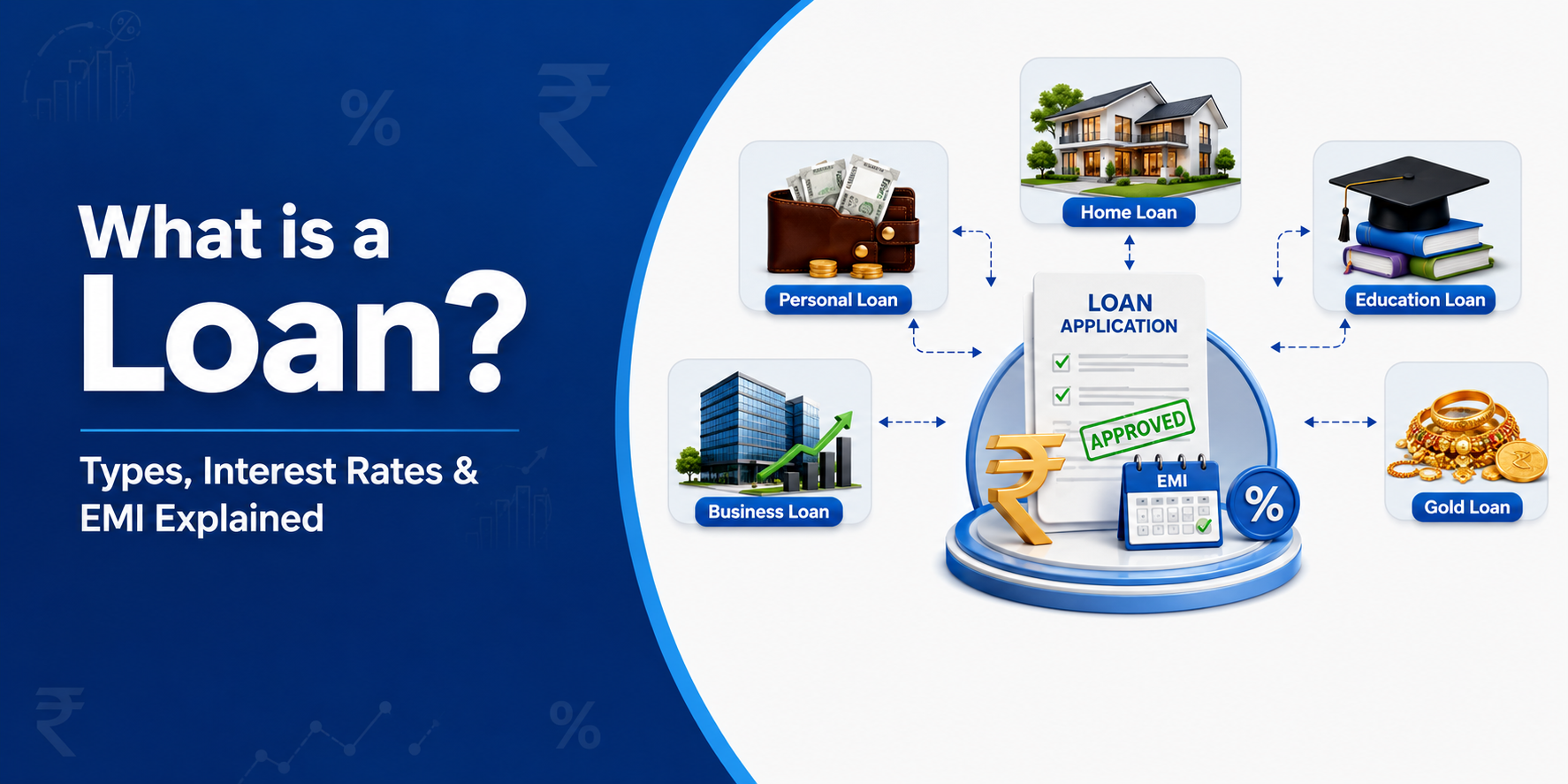

TL;DR: A loan is a financial arrangement where a lender provides a fixed sum of money to a borrower, who repays it with interest in regular instalments over an agreed period. In India, common loan types include home loans, personal loans, education loans, business loans, mudra loans, and gold loans — each designed for a specific financial need.
Borrowing money is something most of us do at some point in life. Whether you’re buying your first home, funding your child’s education, or expanding a small business, a loan can bridge the gap between where you are and where you want to be.
But loans aren’t all the same. They come in different forms, with different interest rates, eligibility requirements, and repayment terms. Understanding what a loan is — and how it works — is the first step toward using one wisely.
This guide explains everything. We start with the basics of loan meaning, then walk through every major loan type available in India, with clear definitions and real numbers.
What is a Loan? The Basic Definition
A loan is a sum of money borrowed from a financial institution — such as a bank, NBFC, or housing finance company — that must be repaid with interest over a fixed period.
The amount you borrow is called the principal. The fee you pay for borrowing is called interest. Repayment typically happens through fixed monthly instalments known as EMIs (Equated Monthly Instalments).
Think of a loan as a financial bridge. It lets you reach a goal today that your savings cannot cover right now.
In India, loans provided by banks are governed by the Reserve Bank of India (RBI). Housing finance specifically falls under the oversight of the National Housing Bank (NHB). Both regulators ensure fair lending practices and protect borrower rights.
Key terms every borrower should know:
- Principal: The original loan amount you borrow from the lender.
- Interest: The cost of borrowing, expressed as a percentage of the principal.
- Tenure: How long you have to repay the loan — from a few months to 30 years.
- EMI: Your fixed monthly repayment amount covering both interest and principal.
- Lender: The bank, NBFC, or housing finance company providing the loan.
- Collateral: An asset you pledge to secure the loan — required for secured loans.
- CIBIL Score: Your credit score, ranging from 300 to 900, based on your repayment history.
How Does a Loan Work?
The process is more straightforward than most people expect. Here is how a typical loan works in India, step by step.
Step 1 — Application: You apply to a bank or financial institution. You provide your personal details, income information, and the purpose of the loan.
Step 2 — Eligibility Assessment: The lender checks your income, credit score, employment history, existing debts, and repayment capacity.
Step 3 — Loan Sanction: If you qualify, the lender approves the loan. They communicate the sanctioned amount, applicable interest rate, and tenure.
Next Step 4 — Documentation: You submit your KYC documents — ID proof, address proof, income documents — along with property papers for secured loans.
Step 5 — Disbursement: The lender transfers the amount to your account or directly to the seller, builder, or institution, depending on the loan type.
Step 6 — Repayment: You pay your EMI every month. Each payment includes a portion of interest and a portion of principal.
This repayment structure — where interest decreases and principal repayment increases over time — is called amortisation. Most loans in India follow this structure.
Types of Loans in India – A Complete Guide
India has a rich and diverse loan market. Different loans serve different purposes, carry different interest rates, and have different eligibility requirements. Below is a comprehensive breakdown of every major loan type.
What is a Home Loan?
A home loan — also called a housing loan — is a secured loan taken to purchase, construct, extend, or renovate a residential property. The property itself serves as collateral until the loan is fully repaid.
Home loans are among the most widely used financial products in India. Government initiatives like PMAY (Pradhan Mantri Awas Yojana) have made home ownership more accessible, particularly for first-time buyers and lower-income groups in Tier 2 and Tier 3 cities.
Key features of home loans:
- Loan tenure: Up to 30 years
- Interest rates: Starting from approximately 8% per annum onwards (floating or fixed based on lender)
- Loan-to-Value (LTV) ratio: Lenders typically finance 75%–90% of the property value
- Tax benefit: Deduction on interest under Section 24(b) and on principal under Section 80C of the Income Tax Act
Home loans also come in several specialised forms:
- Home Construction Loan: For building a house on a plot you already own.
- Home Extension or Renovation Loan: For expanding or upgrading an existing home.
- Home Loan Balance Transfer: For switching your existing loan to a lender offering more competitive rates.
- Top-Up Loan: An additional loan on your existing home loan for personal or home-related needs.
Before applying, it helps to know exactly what you’re eligible for. This Home Loan Eligibility Calculator gives you an instant estimate based on your income, age, and other parameters.
Home First Finance specialises in affordable home loans for first-time buyers in Tier 2 and Tier 3 cities, offering a fully digital application process and transparent terms.
What is a Personal Loan?
A personal loan is from category of unsecured loans — meaning you do not need to pledge any asset as collateral. Lenders evaluate your application based on your income, employment history, and credit score.
Personal loans are highly flexible. You can use them for medical emergencies, weddings, home renovation, travel, gadget purchases, or virtually any personal expense.
Key features of personal loans:
- No collateral required
- Interest rates: Generally higher than secured loans, starting from around 10%–12% onwards depending on your lender and credit profile
- Tenure: Typically 1 to 5 years
- Loans amount: Usually ₹50,000 to ₹40 lakhs depending on your income level
- Disbursement: Often within 24–72 hours with minimal documentation
Because personal loans carry no collateral, lenders charge higher interest rates to compensate for the additional risk they take on.
What is an Education Loan?
An education loan is designed specifically to fund higher studies — in India or abroad. It covers tuition fees, hostel charges, exam fees, books, and sometimes travel costs.
Under the Vidyalakshmi scheme supported by the Government of India, students can access education loans from multiple banks through a single application portal. Most education loans also come with a moratorium period — you begin repaying only after completing your course or securing employment.
Key features of education loans:
- Loan amounts: Up to ₹20 lakhs for studies in India; higher limits apply for abroad education
- Interest rates: Typically starting from 8%–9% onwards depending on the bank and loan amount
- Moratorium: Repayment begins 6–12 months after course completion
- Tax benefit: Interest paid is deductible under Section 80E of the Income Tax Act
- Collateral: Usually not required up to ₹7.5 lakhs; required for higher amounts depending on the lender
Education loans are an investment in future earning potential. Therefore, they remain one of the most financially sound borrowing decisions a student or family can make.
What is a Business Loan?
A business loan provides capital to entrepreneurs, small businesses, and companies for working capital management, equipment purchase, inventory financing, or business expansion.
Business loans are available from banks, NBFCs, and digital lenders. They can be secured (backed by property or equipment) or unsecured (based on business turnover and credit history).
Key features of business loans:
- Interest rates: Start from approximately 10%–12% onwards depending on the lender, business profile, and loan type
- Tenure: Typically 1 to 5 years for unsecured loans; longer for secured options
- Loan amount: From ₹2 lakhs to several crores, depending on the size and financial health of the business
- Documentation: GST returns, ITR, business registration certificate, and bank statements from the last 6–12 months
Access to formal credit is one of the single biggest enablers of growth for India’s MSME sector. Business loans — when used strategically — can generate returns far exceeding their interest cost.
What is a Mudra Loan?
A Mudra loan is a government-backed loan for small businesses and self-employed individuals under the Pradhan Mantri Mudra Yojana (PMMY) scheme. The programme was launched to provide formal credit access to micro enterprises that typically struggle to secure bank funding.
Mudra loans are administered through MUDRA (Micro Units Development & Refinance Agency) and are disbursed through participating banks, NBFCs, and MFIs.
The scheme offers loans under three categories:
| Category | Loan Amount | Target Segment |
|---|---|---|
| Shishu | Up to ₹50,000 | New micro enterprises just starting out |
| Kishore | ₹50,001 to ₹5 lakhs | Established small businesses needing growth capital |
| Tarun | ₹5 lakhs to ₹10 lakhs | Mature enterprises seeking expansion support |
What is a Shishu Mudra Loan? It is the entry-level Mudra loan designed for first-time entrepreneurs and micro businesses. The maximum limit is ₹50,000, and no collateral is required. This makes it highly accessible for those who have just started their self-employment journey.
What is an E-Mudra Loan (SBI E-Mudra)? The E-Mudra is a fully digital Mudra loan offered by banks including SBI. Eligible borrowers can apply and receive funds without visiting a branch. SBI’s E-Mudra portal processes loans up to ₹1 lakh almost instantly for pre-qualified customers with an existing account history.
Mudra loans carry no collateral requirement for the Shishu and Kishore categories. Interest rates are competitive and benchmarked to the lending institution’s base rate.
What is a Gold Loan?
A gold loan is a secured loan where you pledge your gold jewellery, ornaments, or coins as collateral to receive immediate funds. It is one of the fastest loan products in India — typically disbursed within 30 minutes to an hour.
Gold loans are popular in India because gold ownership is widespread across all income groups. Additionally, gold loans require minimal documentation and no strong credit history, making them accessible even to borrowers with no formal credit profile.
Key features of gold loans:
- Secured against physical gold (jewellery, coins, bars)
- Lenders typically offer 75%–85% of the gold’s current market value as the loan amount
- Interest rates: Generally lower than personal loans, starting from approximately 7%–9% onwards
- Tenure: Short-term, typically 3 months to 3 years
- Risk: If you fail to repay, the lender has the right to auction the pledged gold
Gold loans are best suited for short-term, urgent financial requirements. However, they should be repaid within the agreed period to protect your asset.
What is a Mortgage Loan?
Mortgage meaning: A mortgage is a legal arrangement where property is pledged as security for a loan. The lender holds a legal claim over the property until the full loan amount — along with interest — is repaid by the borrower.
In simple terms, every home loan in India is effectively a mortgage. The bank or housing finance company retains the property documents until the loan is cleared.
However, the term “mortgage loan” is also used more broadly in India to refer to any loan secured by immovable property — which includes loan against property as well.
The Reserve Bank of India mandates clear and transparent documentation for all mortgage-based lending. This protects both the lender’s interest and the borrower’s rights throughout the loan period.
What is a Loan Against Property?
A loan against property (LAP) is a secured loan where you mortgage a property you already own — residential, commercial, or industrial — to raise funds. Unlike a home loan that is used to purchase a property, a LAP is taken on something you already hold.
The funds from a LAP can be used for any legitimate financial need — business expansion, higher education, medical treatment, or debt consolidation.
Key features of loan against property:
- Loan amount: Typically 50%–70% of the property’s current market value (this is the LTV ratio)
- Interest rates: Lower than personal loans, generally starting from around 9%–10% onwards
- Tenure: Up to 15 years in most cases
- Tax benefit: No direct personal tax benefit unless funds are used for specific business purposes
However, remember that your property is at risk if you default. Therefore, ensure your monthly income comfortably supports the EMI before applying.
If you already own a property and need significant funds, Home First Finance’s Loan Against Property is a structured option worth exploring.
What is a Secured Loan vs an Unsecured Loan?
This distinction shapes everything — from the interest rate you’re offered to the documentation you need. Here’s a clear comparison.
| Feature | Secured Loan | Unsecured Loan |
|---|---|---|
| Collateral | Required (property, gold, FD) | Not required |
| Interest Rate | Generally lower | Generally higher |
| Loan Amount | Higher, based on asset value | Lower, based on income |
| Risk to Borrower | Asset can be seized if you default | No asset at risk |
| Common Examples | Home loan, Gold loan, LAP | Personal loan, Education loan |
| Processing Time | Longer (includes asset verification) | Faster (income-based assessment) |
| Suitable For | Large, planned borrowing | Short-term, urgent needs |
The core principle is simple. Secured loans are cheaper because the lender has a fallback. Unsecured loans cost more because the lender takes on more risk with no asset to recover against.
What is Interest on a Loan? Understanding Interest Rates
Interest is the cost of borrowing money. When a lender provides you with funds, they charge a percentage of the outstanding principal as their fee. This percentage is the interest rate.
Two primary types of interest rates in India:
Fixed Rate: Your interest rate stays constant throughout the loan tenure. Your EMI never changes, giving you complete predictability in monthly cash flow planning.
Floating Rate: Your interest rate moves with market conditions — specifically, with the RBI’s repo rate. When the RBI increases or cuts the repo rate, your EMI adjusts accordingly. Most home loans in India are on floating rates.
How is monthly interest calculated?
Monthly Interest = (Outstanding Principal × Annual Rate) ÷ 12
For example — if you borrow ₹10 lakh at 9% per year, the first month’s interest is: ₹10,00,000 × 9% ÷ 12 = ₹7,500
As you repay the principal each month, the outstanding amount falls. Consequently, your interest component decreases over time while your principal repayment component increases. This is called amortisation — the gradual reduction of your debt through structured repayments.
The Reserve Bank of India requires all banks and NBFCs to disclose the Annual Percentage Rate (APR) clearly to borrowers. This allows you to compare the true cost across different lenders on an apples-to-apples basis.
What is an EMI? How to Calculate Your Monthly Payment
EMI stands for Equated Monthly Instalment. It is the fixed amount you pay every month to your lender. Each EMI comprises two components — an interest portion and a principal portion.
The EMI formula:
EMI = [P × r × (1+r)^n] ÷ [(1+r)^n – 1]
Where:
- P = Principal loans amount
- r = Monthly interest rate (Annual rate ÷ 12 ÷ 100)
- n = Total number of monthly instalments (tenure in months)
You don’t need to calculate this manually. This Home Loan EMI Calculator does this instantly. Enter the loans amount, interest rate, and tenure — you immediately see your monthly EMI and the total interest payable over the full tenure.
Why tenure selection matters — a practical example:
Assume a home loans of ₹25 lakhs at 9% per annum:
| Tenure | Approximate Monthly EMI | Approximate Total Interest Paid |
|---|---|---|
| 10 years | ~₹31,600 | ~₹13 lakhs |
| 20 years | ~₹22,500 | ~₹29 lakhs |
| 30 years | ~₹20,100 | ~₹47 lakhs |
A longer tenure means smaller monthly EMIs — but you end up paying significantly more interest over time. A shorter tenure costs more monthly but saves substantially on total interest.
If you want to reduce your total interest burden, making periodic prepayments is highly effective. Use the Home First Finance Prepayment Calculator to see exactly how much interest you save by paying extra in a given month or year.
Who is Eligible for a Loan in India?
Eligibility requirements vary by loan type and lender. However, most loans in India share a common set of core criteria.
General eligibility requirements:
- Age: Typically 21 to 60 years at loan application; some home loan lenders extend this to 65 or 70 years for certain borrower profiles
- Income: Minimum monthly income requirements vary by lender and loan type; stability of income matters as much as the amount
- Credit Score: A CIBIL score of 700 or above is generally considered strong; lower scores are sometimes accepted for secured loans with adequate collateral
- Employment: Salaried applicants need stable employment with at least 1–2 years of continuity; self-employed applicants need proof of consistent business income over 2–3 years
- FOIR (Fixed Obligations to Income Ratio): Most lenders prefer that your existing EMI commitments — including the new loan — do not exceed 40%–50% of your gross monthly income
Documents typically required across loan types:
- Identity proof: Aadhaar card, PAN card, passport, or voter ID
- Address proof: Utility bill, rental agreement, or Aadhaar
- Income proof: Last 3 months’ salary slips, last 6 months’ bank statements, and Form 16 for salaried; ITR and business financials for self-employed
- Property documents: Required for all secured loans — title deed, sale agreement, approved building plan
For home loans specifically: The lender also conducts a technical and legal evaluation of the property before disbursement. This is in addition to the borrower’s personal eligibility check.
Benefits of Taking a Loan
Millions of Indians take loans every year — and for good reason. When used wisely, a loan is a powerful financial tool.
1. Achieve major goals without waiting You don’t have to spend decades saving before you can buy a home or fund your child’s education abroad. A loan lets you act on opportunity today.
2. Preserve your savings and investments Instead of liquidating fixed deposits or mutual funds to fund an expense, a loan keeps your savings intact and your investments compounding.
3. Build a credit history Repaying a loan on time consistently improves your CIBIL score. A strong credit score translates to better loan terms, lower interest rates, and faster approvals in the future.
4. Earn tax benefits Several loan types offer meaningful tax deductions:
- Home loan: Deduction on interest under Section 24(b) and principal under Section 80C
- Education loan: Deduction on interest under Section 80E These benefits reduce your effective cost of borrowing considerably.
5. Flexible repayment structure Most lenders allow you to choose your tenure, select from monthly EMI options, and make prepayments when you have surplus funds — giving you meaningful control over your debt management.
6. Leverage for business growth For entrepreneurs, a well-timed business loan can fund expansion that generates returns well above the cost of borrowing. Leverage, used responsibly, is a core growth tool.
Key Factors to Consider Before Taking a Loan
Signing a loan agreement is a long-term commitment. Therefore, evaluate every variable before you decide.
Interest Rate Compare interest rates across multiple lenders before deciding. Even a difference of 0.5% annually can add up to several lakhs over a 20-year home loans tenure.
Floating vs Fixed Rate Floating rates move with the market — they can go down, but they can also rise. Fixed rates offer stability. Choose based on your risk appetite and the current interest rate environment.
Loan Tenure A longer tenure lowers your monthly EMI but increases the total interest outflow. A shorter tenure is the financially smarter choice if your monthly budget can handle the higher EMI.
Processing Fees and Other Charges Most lenders charge a processing fee between 0.5%–2% of the loans amount. Additionally, watch for prepayment penalties (on fixed rate loans), late payment charges, and insurance requirements embedded in the loans.
Prepayment Flexibility Under RBI guidelines, lenders cannot levy prepayment penalties on floating rate loans in India. However, check terms carefully for fixed rate loans before committing. Prepayments significantly reduce total interest cost.
Loan-to-Value (LTV) Ratio For home loans, the LTV ratio determines how much the lender finances. If the LTV is 80%, you need a 20% down payment from your own savings. Factor this into your financial planning before applying.
Lender Credibility and Service A lender’s reputation for transparent terms, responsive customer service, and accessible digital tools matters as much as the interest rate. Read reviews and check for any regulatory complaints before choosing.
Common Loan Mistakes to Avoid
Even financially savvy borrowers make these errors. Here’s what to watch out for.
1. Not checking your credit score before applying Applying for a loan without knowing your CIBIL score is a gamble. A rejection triggers a hard enquiry that lowers your score further. Always check your report, correct any errors, and then apply.
2. Making multiple applications simultaneously Every loan application triggers a hard credit pull. Several pulls in a short period signal financial distress to lenders — and reduce your credit score in the process.
3. Borrowing more than you can comfortably repay A lender approving ₹50 lakhs doesn’t mean you should borrow the full amount. Borrow what you genuinely need and what your monthly income can support without stress.
4. Ignoring the fine print Processing fees, insurance bundling, foreclosure charges, and part-payment restrictions are buried in loan agreements. Read every clause or have someone explain it to you before signing.
5. Comparing only EMI and ignoring total cost A lower EMI often just means a longer tenure — which means far more total interest over the loan’s life. Always compare the total amount payable, not just the monthly instalment.
6. Missing EMI payments Even a single missed EMI can impact your CIBIL score and attract penalties. Set up an auto-debit from your salary account so repayments are never late.
7. Not considering prepayment potential If your income grows over time, making periodic prepayments dramatically reduces your outstanding principal and total interest burden. Plan for this from day one.
Frequently Asked Questions (FAQs)
What is a loan in simple terms?
A loan is money borrowed from a financial institution that must be repaid with interest over a fixed period. The borrowed amount is the principal; the repayment fee is the interest.
What are the main types of loans in India?
The main types are home loans, personal loans, education loans, business loans, gold loans, mudra loans, loan against property, and instant loans. Each serves a specific financial purpose.
What is Credit score and why does it matter?
Credit score is a three-digit credit rating (300–900) based on your repayment history. Most lenders prefer a score of 700 or above. A higher score generally means better interest rates and faster approvals.
What does mortgage meaning refer to in India?
A mortgage means pledging your property as security for a loan. The lender holds a legal claim over the property until the full loan is repaid.
What is EMI full form and how is it calculated?
EMI stands for Equated Monthly Instalment. It is your fixed monthly repayment covering both principal and interest. Use the Home Loan EMI Calculator to calculate yours instantly.
What is the minimum Credit score for a home loan?
Most lenders require a minimum Credit score between 650–700 for home loan approval. Requirements vary by lender and loan amount.
People Also Ask (PAA)
What is the difference between a home loan and a loan against property?
A home loan is taken to buy or build a new property. A loan against property (LAP) is taken by mortgaging a property you already own — and funds can be used for any purpose.
Can I prepay my home loan without penalty?
Yes, for floating rate home loans in India. The RBI prohibits prepayment charges on floating rate loans. Use the prepayment calculator to estimate your interest savings.
What is the meaning of interest on a loan?
Interest is the cost charged by the lender for providing loans. It is expressed as a percentage of the outstanding principal and is calculated monthly or annually based on the loans agreement.
What is NBFC in the context of loans?
NBFC stands for Non-Banking Financial Company. NBFCs like housing finance companies can offer loans, but they do not provide full banking services. They are regulated by the RBI and, for housing finance, by the NHB.
What is FOIR in loan eligibility?
FOIR stands for Fixed Obligations to Income Ratio. It measures what percentage of your income goes toward existing loan EMIs. Most lenders prefer a FOIR below 40%–50% to approve a new loan.
What documents are required for a loan?
Typically: Aadhaar, PAN, salary slips, 6 months’ bank statements, and ITR for self-employed. Property documents are additionally required for secured loans like home loans.
Conclusion
Understanding what a loan is — and how each type works — puts you in a far stronger position when you need to borrow. Whether it’s a personal loan for an emergency, a Mudra loan for your business, an education loan for higher studies, or a gold loan for urgent cash, every loan type has its place when used for the right purpose.
For most Indians, a home loan is the most significant financial commitment of their life. Choosing the right housing finance partner matters enormously. If you’re a first-time home buyer — particularly in a Tier 2 or Tier 3 city — Home First Finance offers affordable home loans with a transparent, fully digital process and dedicated support at every step.
Ready to take the next step? Visit our FAQs page for answers to your specific questions, explore home loan products tailored for affordable housing, or check your eligibility right now with our Home Loan Eligibility Calculator.
Your home journey starts with the right information. You now have it.
Disclaimer: The information shared in this article — including interest rates, EMI calculations, subsidy amounts, property prices, eligibility criteria, and market trends — is meant for general information only. The data is based on publicly available sources, working knowledge, and industry trends available at the time of publication. All figures, examples, and estimates are indicative in nature and should not be treated as official commitments, guarantees, or offers from Home First Finance.