PMAY-U 2.0: Latest Government Updates, Progress & Housing Options
Anurag Sodani • August 5, 2026

India’s cities are growing faster than its housing stock. Millions of urban families still rent, share cramped spaces, or live in informal settlements because a pucca home stays out of reach. PMAY-U 2.0 is the government’s answer to this gap. Launched to extend the “Housing for All” mission, it targets one crore additional urban homes over five years. For anyone planning to buy, build, or rent an affordable home in a city, understanding how PMAY-U 2.0 works — and how it connects to home loan financing — is the first step toward owning a house.
Home First Finance and PMAY: A Quick Note
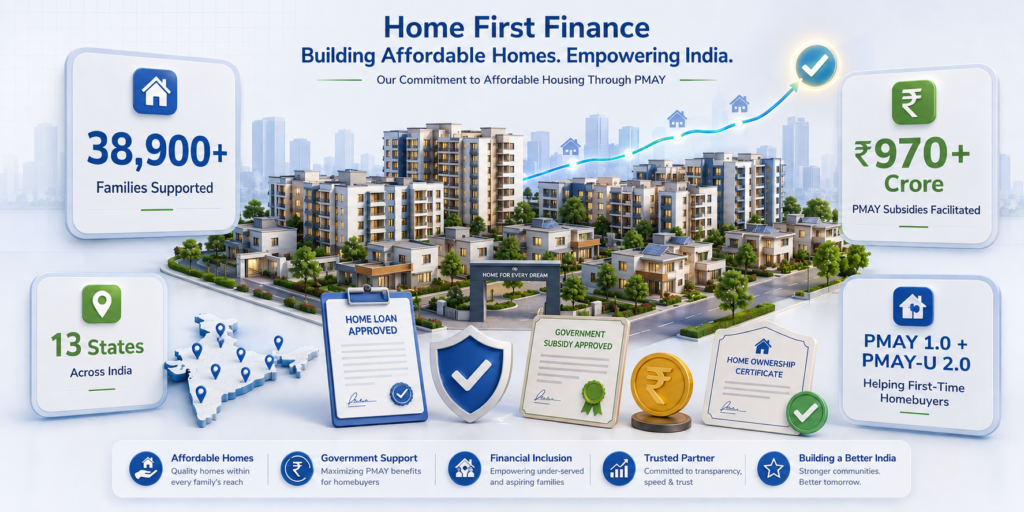
Before we break down the scheme, a word on where we stand. Across PMAY 1.0 and PMAY-U 2.0 combined, Home First Finance has helped over 38,900 customers across 9 states access PMAY subsidies worth more than ₹970 crore — reducing EMIs and accelerating loan repayment for first-time buyers across Tier 2 and Tier 3 cities. We cover this scheme in detail because we work with it daily, not just in theory.
What is PMAY-U 2.0?
PMAY-U 2.0 is the second phase of the Centre’s flagship urban housing programme. It came into effect on 1 September 2024, building on the original Housing for All mission launched in 2015. The Ministry of Housing and Urban Affairs (MoHUA) has informed Parliament that the original PMAY-U scheme runs until 30 September 2026. This gives states and Union Territories time to complete houses already sanctioned, without any change to the funding pattern or implementation mechanism.
The core difference between the two phases lies in scope. PMAY-U 1.0 largely focused on constructing houses. PMAY-U 2.0 introduces four different implementation models to address varying housing needs across urban India, and it aims to support one crore additional eligible urban beneficiaries over the next five years.
Why Was PMAY-U 2.0 Introduced?
India’s urban population keeps rising as people migrate to cities for jobs and education. This growth outpaces the supply of affordable homes in most cities. Many families end up in informal housing without secure tenure, water, or sanitation.
Affordability adds another layer to the problem. Rising land and construction costs push formal homeownership beyond reach for many households, even when they can service a home loan.
A single construction-based scheme cannot solve every version of this problem. Some families need to build on land they already own. Others need ready housing stock built by developers. Migrant workers often need short-term rental housing rather than ownership. Middle-income families need cheaper borrowing costs more than direct construction help. PMAY-U 2.0 responds to this variety with four separate housing models instead of one approach for everyone.
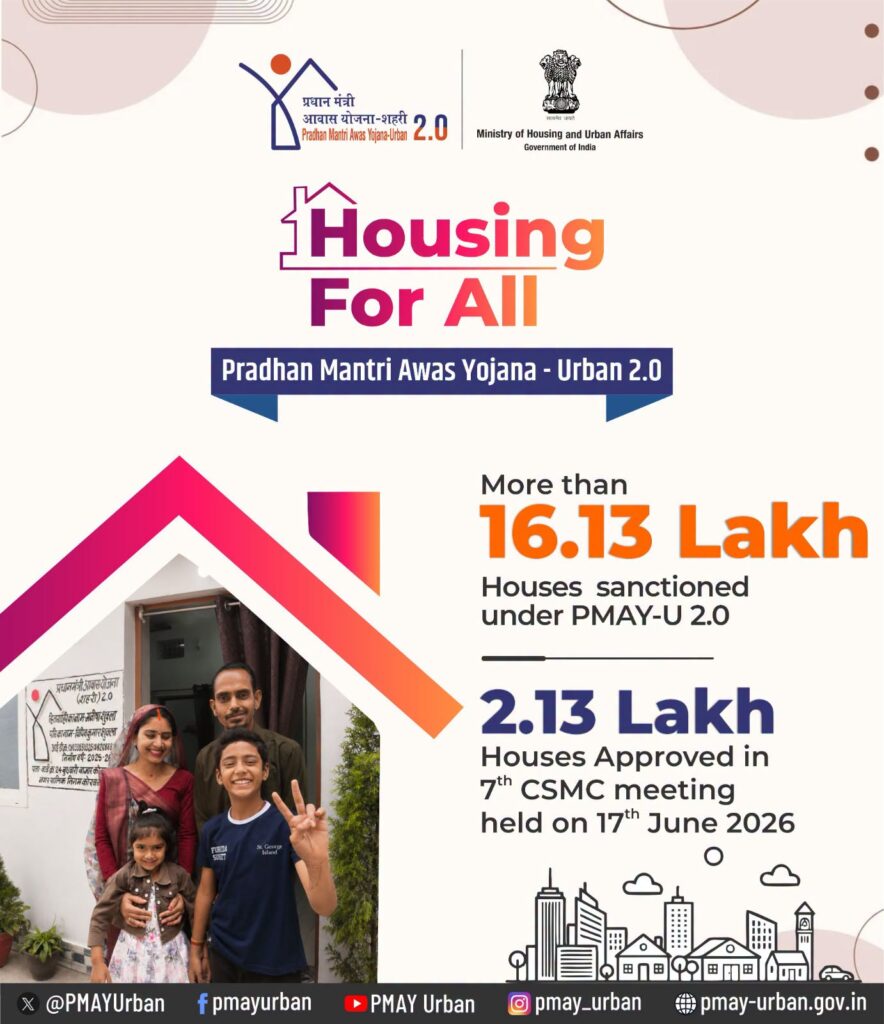
Four Housing Options Under PMAY-U 2.0
PMAY-U 2.0 is a demand-driven scheme. State governments and Union Territories submit proposals after they identify eligible beneficiaries, and houses get sanctioned based on those proposals. States and UTs carry out implementation — demand assessment, beneficiary selection, and project formulation — following scheme guidelines.
| Vertical | What It Offers | Who It Suits Best |
|---|---|---|
| Beneficiary-Led Construction (BLC) | Financial assistance to construct or enhance a house on land the family already owns | Families with their own urban plot but limited construction funds |
| Affordable Housing in Partnership (AHP) | Ready housing projects through public-private partnerships | Families without land who want a ready-to-move-in home |
| Affordable Rental Housing (ARH) | Formal rental accommodation with basic amenities | Migrant workers, students, and the urban poor needing temporary housing |
| Interest Subsidy Scheme (ISS) | Interest subsidy on eligible home loans | EWS, LIG, and MIG families buying or building through a home loan |
Exact subsidy amounts and eligibility conditions follow official guidelines. Applicants should verify current terms on the official PMAY-U portal before assuming a fixed figure.
How Does PMAY-U 2.0 Work?
PMAY-U 2.0 follows a three-tier implementation model. The central government sets policy, funding limits, and guidelines. State governments and Union Territories identify local housing demand and forward project proposals. Urban Local Bodies (ULBs) handle ground-level execution, from beneficiary identification to site supervision.
The process typically follows these steps:
- States and UTs assess housing demand and identify eligible beneficiaries.
- Proposals go to the Central Sanctioning and Monitoring Committee for approval.
- Once sanctioned, states verify individual beneficiaries and formulate the project.
- Construction or allotment begins under the chosen vertical.
- The Ministry monitors progress through reviews, video conferences, and field inspections.
This structure means implementation speed varies by state, since local capacity and land availability differ widely across India.
PMAY-U 2.0 Progress Report (Latest Government Data)
Minister of State for Housing and Urban Affairs Tokhan Sahu shared this progress data in a written reply in the Rajya Sabha. As of 13 July 2026, the combined status of PMAY-U and PMAY-U 2.0 stood as follows:
| Milestone | Number |
|---|---|
| Total Houses Sanctioned (since 2015) | 127.68 lakh |
| Houses Grounded for Construction | 121.02 lakh |
| Houses Completed and Delivered | 99.07 lakh |
| Houses Sanctioned Under PMAY-U 2.0 Alone | 16.20 lakh |
These numbers show that roughly 95% of sanctioned houses have moved into active construction, and about 78% are already complete. The ministry confirmed that construction of the remaining sanctioned houses is underway. That gap between grounding and completion reflects the average 12 to 36-month construction timeline, not stalled projects.
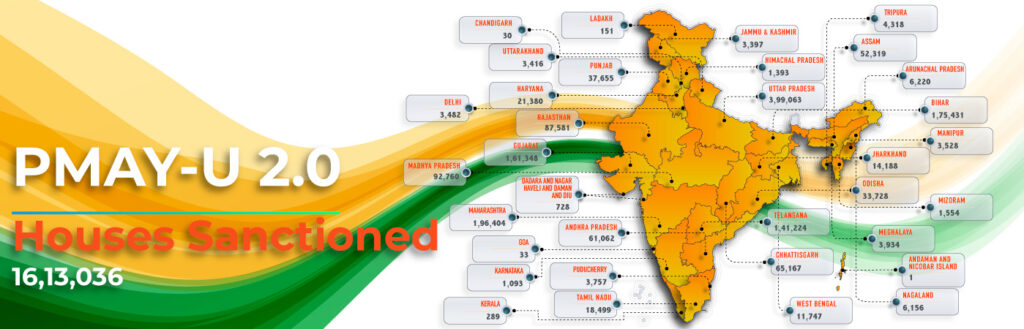
State Spotlight: Tamil Nadu
The ministry also shared state-wise data highlighting Tamil Nadu’s progress under the scheme.
| Tamil Nadu Metric | Figure |
|---|---|
| Total Houses Sanctioned | 6.86 lakh |
| Sanctioned Under PMAY-U 2.0 Alone | 18,000 (0.18 lakh) |
| Houses Grounded | 6.74 lakh |
| Houses Completed | 6.32 lakh |
Tamil Nadu shows a completion rate above 92% of its sanctioned houses, placing it among the better-performing states nationally. This pace varies elsewhere. States with more recent sanctions, larger land acquisition backlogs, or newer entries into the ARH and BLC verticals typically show lower completion percentages at this stage.
Why Do Housing Projects Take Time?
The Centre has confirmed that construction timelines vary across projects and states, with most houses taking 12 to 36 months to complete depending on project type and the Detailed Project Report (DPR). Delays can arise from several factors:
- Availability of encumbrance-free land, which construction cannot begin without.
- Statutory approvals, including local building and environmental clearances.
- Beneficiary contribution, where families must arrange their share of project funding.
- State-specific implementation challenges, including staffing and administrative bandwidth.
The ministry reviews progress regularly through meetings, video conferences, and field inspections to speed up construction. States and UTs must complete sanctioned houses within DPR-prescribed timelines.
Tip: If your application status shows “grounded but not completed,” this usually means your project is progressing through one of these stages rather than facing a problem.
Quality Standards and Civic Infrastructure
Houses under PMAY-U must comply with prescribed technical standards and local building by-laws. Beyond housing itself, the scheme works to ensure access to basic civic amenities through convergence with central and state government programmes:
- Drinking water supply
- Sanitation facilities
- Electricity connections
- Road connectivity
Implementing agencies run quality assurance and inspection mechanisms to check compliance with these standards, and the Centre conducts periodic reviews with states and UTs. Integrated infrastructure matters because a house without water or road access does not fully solve the housing problem — it just relocates it.
What PMAY-U 2.0 Means for Home Buyers
For prospective home buyers, PMAY-U 2.0 changes the calculation in a few concrete ways.
More affordable supply is entering the market. With over 127 lakh houses sanctioned and nearly 100 lakh completed, more formal, amenity-equipped housing stock is becoming available in cities across India.
Financing gets cheaper for eligible buyers. The Interest Subsidy Scheme under PMAY-U 2.0 can reduce the effective cost of a home loan for EWS, LIG, and MIG applicants, which lowers monthly EMIs over the loan tenure.
Eligibility checks come first. Income category, property ownership status, and city coverage all determine whether you qualify. Confirm your eligibility and check the PMAY subsidy calculator before applying, so you know what savings to expect.
Planning finances matters as much as planning the application. A home loan combined with a PMAY-U 2.0 subsidy still requires stable income proof, a manageable EMI-to-income ratio, and the right documentation.
How Home First Finance Has Helped Customers Benefit from PMAY
At Home First Finance, helping first-time home buyers navigate PMAY subsidies is not new territory for us. Across PMAY 1.0 and PMAY-U 2.0 combined, we have helped over 38,900 customers across 9 states unlock PMAY subsidies worth more than ₹970 crore — making EMIs lighter and the path to full homeownership faster. These are not just numbers — they represent families in Tier 2 and Tier 3 cities who turned a government scheme into a real reduction in what they owe every month.
What makes Home First a strong lending partner for PMAY applicants is how we are built. We specialise in first-time home buyers, including salaried workers with informal income documentation and self-employed individuals who often struggle to qualify with larger banks. Our loan processing is digital-first, which means faster turnaround on approvals and subsidy coordination — important when beneficiary timelines are tied to project DPRs. We work across EWS, LIG, and MIG income segments, so whether you qualify for BLC, AHP, or the Interest Subsidy Scheme under PMAY-U 2.0, we can structure your home loan accordingly.
At Home First, we work with first-time home buyers, self-employed individuals, and salaried applicants across income segments to structure home loans that align with PMAY-U 2.0 eligibility. If you’re planning to apply, our guide on how to apply for PMAY online walks through the process step by step, and our PMAY overview page covers eligibility criteria in detail. We don’t administer the government scheme itself, but we help eligible buyers plan the financing side so a PMAY-U 2.0 subsidy translates into an actual home loan approval.
Frequently Asked Questions
Is PMAY-U 2.0 active?
Yes. It came into effect on 1 September 2024 and runs for five years, alongside the extended PMAY-U 1.0, with implementation running through 2029.
Who implements PMAY-U 2.0?
The central government sets policy and funding. State governments and Union Territories handle demand assessment, beneficiary selection, and project execution.
How many houses have been sanctioned under PMAY-U 2.0?
As of 13 July 2026, 16.20 lakh houses have been sanctioned under PMAY-U 2.0 alone, out of 127.68 lakh sanctioned across both phases combined.
What are the four components of PMAY-U 2.0?
Beneficiary-Led Construction (BLC), Affordable Housing in Partnership (AHP), Affordable Rental Housing (ARH), and the Interest Subsidy Scheme (ISS).
How long do PMAY housing projects take to complete?
Typically 12 to 36 months, depending on the project type and the Detailed Project Report timelines.
What amenities are included in PMAY-U 2.0 homes?
Drinking water supply, sanitation facilities, electricity connections, and road connectivity, delivered through convergence with other government programmes.
Is PMAY-U available in every city?
Coverage depends on state and Union Territory participation. Check the official PMAY-U portal for your city’s status.
Can self-employed individuals benefit under PMAY-U 2.0?
Yes, if they meet the income category and property ownership criteria for EWS, LIG, or MIG segments, regardless of employment type.
Can I combine a home loan with PMAY-U 2.0 benefits?
Yes. Eligible applicants can apply the Interest Subsidy Scheme to a home loan, reducing the effective borrowing cost. Confirm your eligibility with your lender before applying.
Source: The Times of India, reporting Ministry of Housing and Urban Affairs data shared in the Rajya Sabha by Minister of State Tokhan Sahu. For official guidelines, visit the PMAY-U 2.0 portal.
PMAY 2.0 Guides
How to Apply for PMAY 2.0 Online PMAY-U 2.0 Explained with Example PMAY 1.0 vs PMAY 2.0 PMAY Documents Checklist PMAY 2.0 FAQs PMAY 2.0 Subsidy Benefits PMAY Success StoriesHome Loan Calculators
PMAY 2.0 Subsidy Calculator Home Loan Eligibility Calculator Home Loan EMI Calculator Home Loan Prepayment CalculatorFrequently Searched
15 Lakh Home Loan 20 Lakh Home Loan 25 Lakh Home Loan 30 Lakh Home Loan 40 Lakh Home Loan 50 Lakh Home Loan Home Loan for ₹20,000 Salary Home Loan for ₹30,000 Salary Home Loan for ₹40,000 Salary Home Loan for ₹50,000 SalaryExplore Home Loans
Home Loan PMAY 2.0 Construction Loan Home Extension Loan Home Loan Top Up Loan Against PropertyFind a Home First Branch
Home Loan Near Me Home Loan in Mumbai Home Loan in Bengaluru Home Loan in Hyderabad Home Loan in Chennai Home Loan in Pune Branch Locator