Documents Required for Home Loan in India: Complete Checklist for Salaried, Self-Employed, NRI & Other Applicants (2026)
Anurag Sodani • June 12, 2026
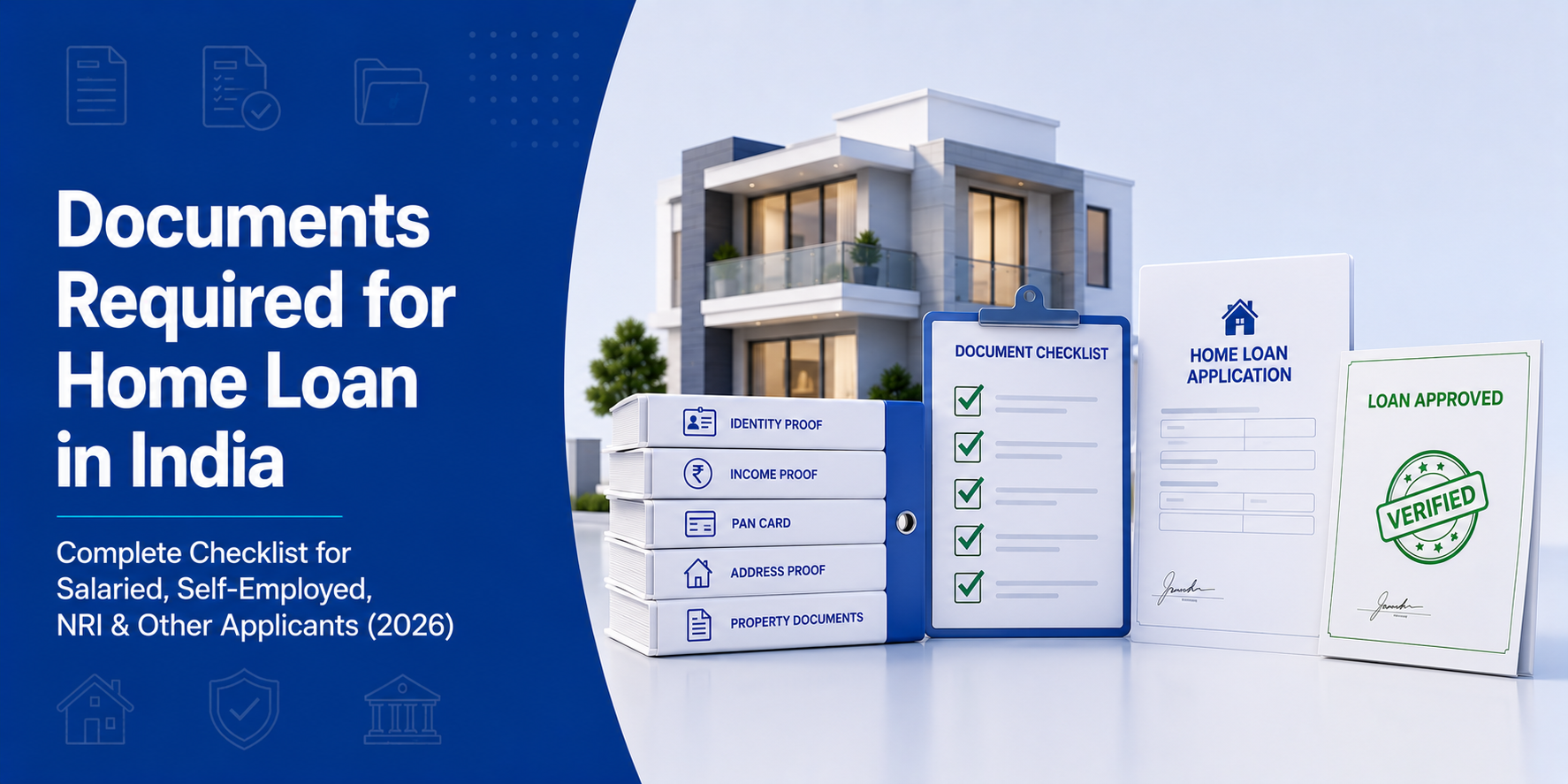
TL;DR: Home loan documentation typically falls into four buckets — KYC documents, income proof, banking documents, and property papers. The exact list varies depending on whether you’re salaried, self-employed, an NRI, applying under PMAY, or buying a resale property. Submitting the correct paperwork the first time plays the biggest role in speeding up your loan approval process.
If you’ve ever applied for a home loan, you know the feeling — a checklist that seems to grow every time you check it off. Why do lenders need so much paperwork for something as simple as buying a house?
The answer is straightforward. A home loan is a long-term commitment, often 15 to 30 years, and the lender is putting a significant amount of money on the line based on your ability to repay and the legal soundness of the property you’re buying. Documentation is how lenders verify both.
This guide walks through exactly what’s required — for every type of applicant, every type of property, and every special scheme — so you can prepare everything in one go instead of running back and forth.
Why Lenders Require Documentation
Every document you submit answers one of three questions for the lender: who are you, can you repay this loan, and is the property you’re buying legally sound?
KYC documents confirm your identity and address. Income documents establish your repayment capacity — this is where the lender calculates your EMI affordability. Property documents confirm that the asset being mortgaged actually belongs to the seller, has clear title, and is legally constructed.
Each of these checks protects both sides. For the lender, it reduces the risk of default or legal disputes over the property later. For you, it ensures you’re not unknowingly buying into a property with title issues, pending dues, or unapproved construction — problems that could surface years after you’ve moved in.
How Complete Documentation Speeds Up Approval
Loan processing delays are rarely about the loan amount or your credit score — they’re usually about missing or mismatched paperwork.
When your file goes to the credit and legal teams complete on the first attempt, it moves through verification in one pass. When something’s missing, the file gets parked, a query is raised, you submit the missing document, and the file goes back into the queue — often behind newer applications.
A complete file submitted upfront can mean the difference between a sanction letter in a week versus three weeks of back-and-forth. This is especially true for property documents, since legal verification of title and ownership chain takes time regardless of how good your income profile is.
Importance of Property and Income Verification
These two verification streams run in parallel, but they serve different purposes.
Income verification determines your loan eligibility — how much the lender is comfortable lending you based on your monthly income, existing obligations, and repayment history. This is where your salary slips, ITRs, and bank statements come in.
Property verification determines whether the asset is acceptable as collateral. The lender’s legal team checks the chain of ownership, confirms there’s no existing mortgage or dispute on the property, and verifies that construction has the necessary municipal approvals. This is why an Encumbrance Certificate and approved building plan matter just as much as your salary slip.
Both checks happen simultaneously, but a delay in either one holds up your overall sanction. That’s why preparing both sets of documents together, rather than sequentially, saves time.
Required Documents List for Home Loan
KYC Documents
Identity Proof (any one of the following):
- Aadhaar Card
- PAN Card
- Passport
- Driving Licence
- Voter ID
Address Proof (any one of the following):
- Aadhaar Card
- Passport
- Recent Utility Bills (electricity, water, or gas, usually not older than 2-3 months)
- Registered Rental Agreement
Photograph:
- Recent passport-size photographs (usually 2-4 copies)
PAN is mandatory for all home loan applications regardless of loan amount, since it’s required for income tax and TDS purposes related to the loan.
Income Documents Required for Home Loan
For Salaried Employees
Employment Documents:
- Employee ID Card
- Appointment Letter
- Employment Confirmation Letter (for those still on probation or recently confirmed)
Income Proof:
- Last 3-6 months’ salary slips
- Form 16 for the last 1-2 financial years
- Latest filed ITR, if available
Banking Documents:
- Last 6-12 months’ bank statements (preferably the account where salary is credited)
Documents Required for Cash-Salaried Applicants
This is one of the most important categories for borrowers in Tier 2 and Tier 3 cities, where many employees receive part or all of their salary in cash rather than through a formal bank transfer.
If you don’t have standard salary slips, lenders typically accept the following as alternatives:
Income Proof Alternatives:
- Salary Certificate issued by the employer on letterhead
- Employer Declaration Letter confirming your monthly income and role
- Bank statements showing regular cash deposits that align with your declared income
- A cash flow assessment, where the lender reviews your overall household income pattern, including contributions from multiple earning members
- Household income documents, where income from a spouse or family business is considered jointly
Additional Documents:
- Proof of work experience, such as an ID card or appointment letter, even without formal payslips
- Repayment track record on any existing loans (personal loan, two-wheeler loan, gold loan), which helps establish your credit discipline even without a long bank statement history
Lenders who specialise in affordable housing finance are generally well-equipped to assess cash-salaried applicants through a combination of these documents, rather than insisting on a salary slip that simply doesn’t exist for many borrowers in this segment.
Documents Required for Self-Employed Applicants
Self-employed applicants — whether professionals, traders, or small business owners — submit a different set of documents focused on business continuity and financial stability.
Business Proof:
- GST Registration Certificate
- Shop & Establishment Certificate
- Business Registration Certificate (Partnership Deed, LLP Agreement, or Certificate of Incorporation, as applicable)
- Trade Licence issued by the local municipal authority
Financial Documents:
- Last 2-3 years’ Income Tax Returns (ITRs) with computation of income
- Balance Sheet for the last 2-3 years
- Profit & Loss Statement for the last 2-3 years
- CA-certified financial statements, where applicable
Banking Documents:
- Current account statements (business account) for the last 6-12 months
- Savings account statements for the last 6-12 months
For self-employed non-professionals running smaller businesses — kirana stores, small manufacturing units, service providers — lenders often place additional weight on banking patterns and business vintage when formal financial statements are limited.
Documents Required for Women Home Loan Applicants
Women applicants generally submit the same core documents as any other applicant — KYC, income proof, banking documents, and property papers based on their employment category (salaried, self-employed, or cash-salaried).
Additional Scenarios:
- Joint ownership documents: If the property is being co-owned, ownership proof reflecting both names is required
- Co-applicant documents: Full KYC and income documents for any co-applicant (commonly a spouse or parent)
- Marriage certificate: Required if your name appears differently across documents (for example, maiden name on PAN versus married name on Aadhaar)
- Property ownership proof: Where the property is being registered solely or jointly in the woman applicant’s name
Benefits Available to Women Homebuyers
Many states offer a stamp duty concession for women buyers when the property is registered solely in their name — this varies by state, so it’s worth checking with your local sub-registrar office or state revenue department.
Women applicants under PMAY (Pradhan Mantri Awas Yojana) also receive specific consideration — under most PMAY components, having a woman as the owner or co-owner of the property is a key eligibility criterion, making this an important factor when planning the documentation for a PMAY-linked home loan.
Documents Required for NRI Home Loan Applicants
NRI home loans involve additional documentation because the lender needs to verify both your overseas status and your ability to service the loan from foreign income.
Identity Documents:
- Valid Passport
- Valid Visa or Residence Permit
- OCI Card or PIO Card, if applicable
Overseas Address Proof:
- Recent utility bills from your country of residence
- Overseas rental agreement
- Overseas bank statements showing your current address
Employment Documents:
- Employment Contract or Offer Letter
- Work Permit / Visa with employment authorisation
- Employer Certificate confirming designation, salary, and tenure
Income Documents:
- Overseas salary slips for the last 3-6 months
- Foreign bank account statements for the last 6-12 months
- Tax returns filed in the country of residence, where applicable
Power of Attorney (POA) Documents:
- Notarized Power of Attorney authorising someone in India to execute documents on your behalf
- Embassy-attested documents, where the POA or other documents are executed overseas and need attestation by the Indian Embassy or Consulate before they’re valid in India
NRI applications also require an NRE or NRO bank account in India, into which loan disbursements and EMI payments are typically routed.
Documents Required for Defence and Armed Forces Personnel
Defence personnel often have unique postings and income structures, so lenders accept a specific set of service-related documents alongside standard KYC.
Employment Documents:
- Defence ID Card
- Service Certificate issued by the relevant department
- Posting Letter or Last Posting Order
Income Proof:
- Salary Slips (often available through the relevant pay disbursing authority)
- Bank statements showing salary credits
- Form 16, where applicable
Additional Documents:
- Pension documents, for retired personnel applying for a loan based on pension income
- Service records, where the lender needs to verify length of service or rank for eligibility purposes
Many lenders offer simplified processing for defence personnel given the stability of government employment, though the documentation requirements themselves remain largely similar to salaried applicants.
Documents Required for PMAY Subsidy with Home Loan
The Pradhan Mantri Awas Yojana (PMAY) offers an interest subsidy on home loans for eligible first-time buyers, but availing it requires additional documentation alongside your standard loan papers.
PMAY Eligibility Documents:
Identity & Address Proof:
- Aadhaar Card (mandatory for PMAY applications)
- PAN Card
Income Documents:
- Salary Slips
- Income Tax Returns (ITR)
- Income Certificate, where ITR isn’t available (common for informal income earners)
Property Documents:
- Property Purchase Agreement
- Sale Deed (or Agreement to Sell, at the application stage)
- Approved Building Plan
Self-Declaration Documents:
- Declaration that the applicant or any family member does not already own a pucca house anywhere in India
- Family ownership declaration, confirming the composition of the household for income category assessment (EWS, LIG, or MIG)
Additional Documents:
- Loan Sanction Letter from the lender
- Home Loan Account Details, since the subsidy is credited against the loan account
Since PMAY eligibility depends on income category, family composition, and whether you or your family already own a home anywhere in the country, it’s worth reviewing the latest scheme guidelines on the official PMAY-Urban portal before applying, as criteria and components are periodically updated.
Property Documents Required for Home Loan
For New Property
Builder Documents:
- Allotment Letter from the builder
- Builder-Buyer Agreement (Agreement for Sale)
- Approved Building Plan sanctioned by the local municipal authority
- No Objection Certificate (NOC) from the builder, where applicable (especially for under-construction properties)
Property Documents:
- Sale Agreement
- Occupancy Certificate (for ready-to-move properties)
- Completion Certificate, confirming construction is complete as per the approved plan
Documents Required for Home Loan on Resale Property
Resale transactions involve an additional layer of verification, since the lender needs to trace ownership history and confirm the property is free of any prior liabilities.
Seller Documents:
- Previous Sale Deed (the document under which the current seller acquired the property)
- Chain of Ownership Documents, tracing the property’s title history back through previous transfers
Property Verification Documents:
- Encumbrance Certificate (EC), confirming the property has no pending loans, mortgages, or legal disputes for the period covered
- Property Tax Receipts, showing dues are paid up to date
- Occupancy Certificate
- Society NOC, where the property is part of a housing society (confirming no objection to the transfer and updating share certificate records)
Buyer Documents:
- Sale Agreement between buyer and seller
- Standard KYC documents
- Standard income documents based on employment category
The Encumbrance Certificate is particularly important for resale properties — it’s the document that confirms the seller actually has a clear, transferable title, free from any existing mortgage that hasn’t been formally closed.
Documents Required for Plot / Land Loan
Loans for purchasing a plot of land (without immediate construction) require land-specific title and ownership documents in addition to standard borrower documents.
Land Documents:
- Sale Deed
- Title Documents establishing the seller’s ownership
- Approved Layout Plan from the local development authority
- Land Conversion Certificate, where agricultural land has been converted for residential use
Ownership Documents:
- Mutation Records, confirming the property records have been updated to reflect the current owner’s name in revenue records
- Property Tax Receipts
Borrower Documents:
- Income Proof based on employment category
- Bank Statements
- Standard KYC Documents
Plot loans typically have stricter conditions around construction timelines, so it’s worth understanding these conditions at the application stage itself.
Documents Required for Home Construction Loan
If you already own a plot and want to build a house on it, a construction loan requires documents that establish both your ownership of the land and your construction plan.
Required Documents:
- Land Ownership Documents (Sale Deed, Title Documents, Mutation Records)
- Approved Building Plan sanctioned by the local municipal or development authority
- Construction Estimate prepared by an architect or civil engineer
- Architect Certificate confirming the estimate and plan
- Contractor Agreement, where construction is being outsourced
- Cost Breakdown, itemising the construction cost across stages (foundation, structure, finishing, etc.)
Construction loans are typically disbursed in stages, linked to construction progress, so lenders may request periodic photographs or engineer certifications as construction proceeds.
Documents Required for Home Improvement / Renovation Loan
For loans aimed at renovating or extending an existing home, documentation focuses on proving ownership and the scope of work planned.
Required Documents:
- Property Ownership Proof (existing Sale Deed or title documents)
- Renovation Estimate detailing the planned work and costs
- Contractor Quotations supporting the estimate
- Municipal Approvals, where structural changes require local authority sanction
Documents Required for Home Loan Top-Up
A top-up loan is an additional loan over and above your existing home loan, often used for renovation, education, or other personal needs. Since the lender already has your property on record, documentation focuses on your existing loan and updated income status.
Existing Loan Documents:
- Original Loan Sanction Letter
- Loan Account Statement showing repayment history
- Repayment Track Record (typically the last 12 months, demonstrating no missed EMIs)
Income Documents:
- Latest Salary Slips
- Latest filed ITR
- Recent Bank Statements
Property Documents:
- Existing Property Papers already held by the lender
- Updated Ownership Documents, if there have been any changes since the original loan
Because you have already mortgaged the property with the same lender, the lender can process a top-up loan faster than a fresh home loan application, provided you maintain a clean repayment track record.
Home Loan Documentation Checklist: Must-Haves
Here’s a quick-reference summary table covering the core documents most applicants will need, regardless of category.
| Category | Documents |
|---|---|
| Identity Proof | Aadhaar, PAN, Passport, Driving Licence, or Voter ID (any one) |
| Address Proof | Utility Bill, Passport, Aadhaar, or Rental Agreement (any one) |
| Income Proof | Salary Slips, Form 16, ITR (or alternatives for cash-salaried applicants) |
| Banking Documents | 6-12 months’ bank account statements |
| Property Documents | Sale Deed, Encumbrance Certificate, Occupancy Certificate, Property Tax Receipts |
| Special Category Documents | PMAY declarations, NRI POA/visa documents, Defence service certificates, Top-up loan statements |
Home Loans Are for All – Salaried and Self-Employed People
One of the most common misconceptions about home loans is that they’re only accessible to salaried employees with formal payslips. In reality, lenders today work with a wide spectrum of borrower profiles, each with a documentation pathway suited to their income pattern.
Salaried borrowers with formal employment provide the most straightforward documentation — salary slips, Form 16, and bank statements showing salary credits.
Self-employed professionals — doctors, chartered accountants, architects, consultants — submit professional registration proof along with ITRs and financial statements reflecting their practice income.
Self-employed non-professionals, including traders and shop owners, rely on business registration documents, GST filings, and banking patterns to demonstrate income stability.
Small business owners in manufacturing, retail, or services follow a similar path, often with additional weight placed on business vintage and banking turnover.
Cash-salaried employees, common across Tier 2 and Tier 3 cities, use employer declarations, salary certificates, and household income assessments in place of formal payslips.
First-time homebuyers generally follow the documentation requirements that match their employment category and may also qualify for a PMAY subsidy if they meet the eligibility criteria.
Women borrowers submit the same core documents as any applicant, with potential additional benefits around stamp duty and PMAY eligibility as discussed earlier.
NRIs follow an extended documentation path covering overseas employment, foreign income, and Power of Attorney arrangements for executing documents in India.
Defence personnel use service-specific documents alongside standard income proof, often benefiting from the stability associated with government service.
Across all these categories, lenders use documentation to verify two key factors—your repayment capacity and the property’s legal standing—through document types that reflect your income structure.
Common Reasons for Home Loan Document Rejection
Even strong applications can stall over surprisingly small issues. Here are the most frequent ones to watch for.
PAN and Aadhaar mismatch: If your name, date of birth, or other details don’t match exactly across your PAN and Aadhaar, this can trigger a query or delay during KYC verification.
Incomplete bank statements: Submitting statements with gaps, missing pages, or statements that don’t cover the full required period (typically 6-12 months) is one of the most common causes of delay.
Missing property title documents: For resale or older properties, gaps in the chain of ownership documents — especially missing intermediate sale deeds — can hold up legal verification significantly.
Unclear income proof: For self-employed or cash-salaried applicants, income documentation that doesn’t align with bank statement patterns (for example, declared income much higher than what reflects in banking) can raise red flags.
Incomplete KYC: Missing photographs, expired identity documents, or address proof that doesn’t match your current residence can all cause processing delays.
Incorrect builder documents: For under-construction properties, an Allotment Letter or Builder-Buyer Agreement that doesn’t match the approved building plan, or a builder NOC that’s missing entirely, is a common bottleneck.
The good news is that almost all of these issues are preventable simply by cross-checking your documents against each other before submission — particularly ensuring your name and address are consistent across every document you provide.
Frequently Asked Questions
What documents are essential for home loan approval?
At a minimum, you’ll need identity proof (Aadhaar/PAN), address proof, recent photographs, income proof (salary slips/ITR based on employment type), bank statements for 6-12 months, and property documents including the sale agreement and title papers.
What are the documents required for a home loan?
The core categories are KYC documents, income documents (varying by salaried, self-employed, or cash-salaried status), banking documents, and property documents (sale deed, encumbrance certificate, and approvals depending on whether the property is new, resale, or under construction).
Can I get a home loan without salary slips?
Yes. Cash-salaried and informally employed applicants can use alternatives such as an employer salary certificate, employer declaration letter, bank statements showing regular income deposits, and a household cash flow assessment in place of formal salary slips.
How can a cash-salaried employee apply for a home loan?
By providing an employer-issued salary certificate or declaration, bank statements reflecting income deposits, proof of work experience, and details of any existing loan repayment history to demonstrate income stability and creditworthiness.
What documents are required for PMAY subsidy?
Along with standard KYC and income documents, you’ll need Aadhaar, an income certificate (if ITR isn’t available), property purchase agreement or sale deed, approved building plan, and a self-declaration confirming you don’t already own a pucca house.
People Also Ask (PAA)
What documents are essential for home loan approval?
At a minimum, you’ll need identity proof (Aadhaar/PAN), address proof, recent photographs, income proof (salary slips/ITR based on employment type), bank stat
What documents are required for NRI home loans?
NRIs need a valid passport and visa, overseas address proof, employment contract and employer certificate, overseas salary slips and foreign bank statements, and often a notarized (and where required, embassy-attested) Power of Attorney for executing documents in India.
Which documents are required for a resale flat home loan?
You’ll need the previous sale deed and chain of ownership documents from the seller, an Encumbrance Certificate, property tax receipts, an occupancy certificate, society NOC (if applicable), plus your own standard KYC and income documents.
What documents are required for a land loan?
A sale deed and title documents for the land, an approved layout plan, land conversion certificate (if applicable), mutation records, property tax receipts, and your standard income and KYC documents.
What documents are required for a home loan top-up?
Your existing loan sanction letter, loan account statement, repayment track record, updated income documents (latest salary slips/ITR), and your existing property papers already held by the lender.
Are property documents mandatory for home loan approval?
Yes. Property documents are essential because they confirm legal ownership and title, which the lender needs to verify before creating a mortgage on the property as security for the loan.
How many months of bank statements are required for a home loan?
Most lenders require 6-12 months of bank statements, though this can vary slightly depending on the lender and your employment category.
Do women applicants need separate documents for a home loan?
Not separately — women applicants submit the same core KYC, income, and property documents as any applicant. Additional documents like a marriage certificate may be needed only if there’s a name mismatch across records.
What documents do defence personnel need for a home loan?
A defence ID card, service certificate, posting letter, salary slips or pension documents (for retired personnel), and bank statements, along with standard KYC documents.
How long does home loan document verification take?
This varies by lender and case complexity, but a complete, well-organised document set generally moves through verification faster than a file with missing or mismatched documents, which require additional back-and-forth before processing can continue.
Can I get a home loan if some property documents are unavailable?
It depends on which documents are missing. Core title documents like the sale deed and chain of ownership are usually essential, but lenders may guide you on obtaining duplicates or alternative proofs for documents like old property tax receipts through the relevant municipal office.
How do lenders verify property documents before approving a home loan?
Lenders typically conduct a legal verification of the title chain and an Encumbrance Certificate check to confirm there are no existing claims on the property, alongside a technical verification to confirm the construction matches approved plans.
Final Thoughts
Home loan documentation can feel overwhelming at first glance, but it follows a logical structure once you break it down: who you are, how much you earn, and what you’re buying. Whether you’re salaried, self-employed, an NRI, applying under PMAY, or buying a resale flat, the core principle is the same — a complete, consistent document set is the fastest route to approval.
Before you start gathering paperwork, it helps to know what you can realistically borrow. Use the Home Loan Eligibility Calculator to get a sense of your loan amount, and the Home Loan EMI Calculator to plan your monthly budget. If you’re exploring the PMAY subsidy, the official PMAY-Urban portal is the best source for current eligibility criteria and required declarations.