Encumbrance Certificate in Tamil Nadu: TNREGINET Portal & Legal Due Diligence
Anurag Sodani • June 10, 2026
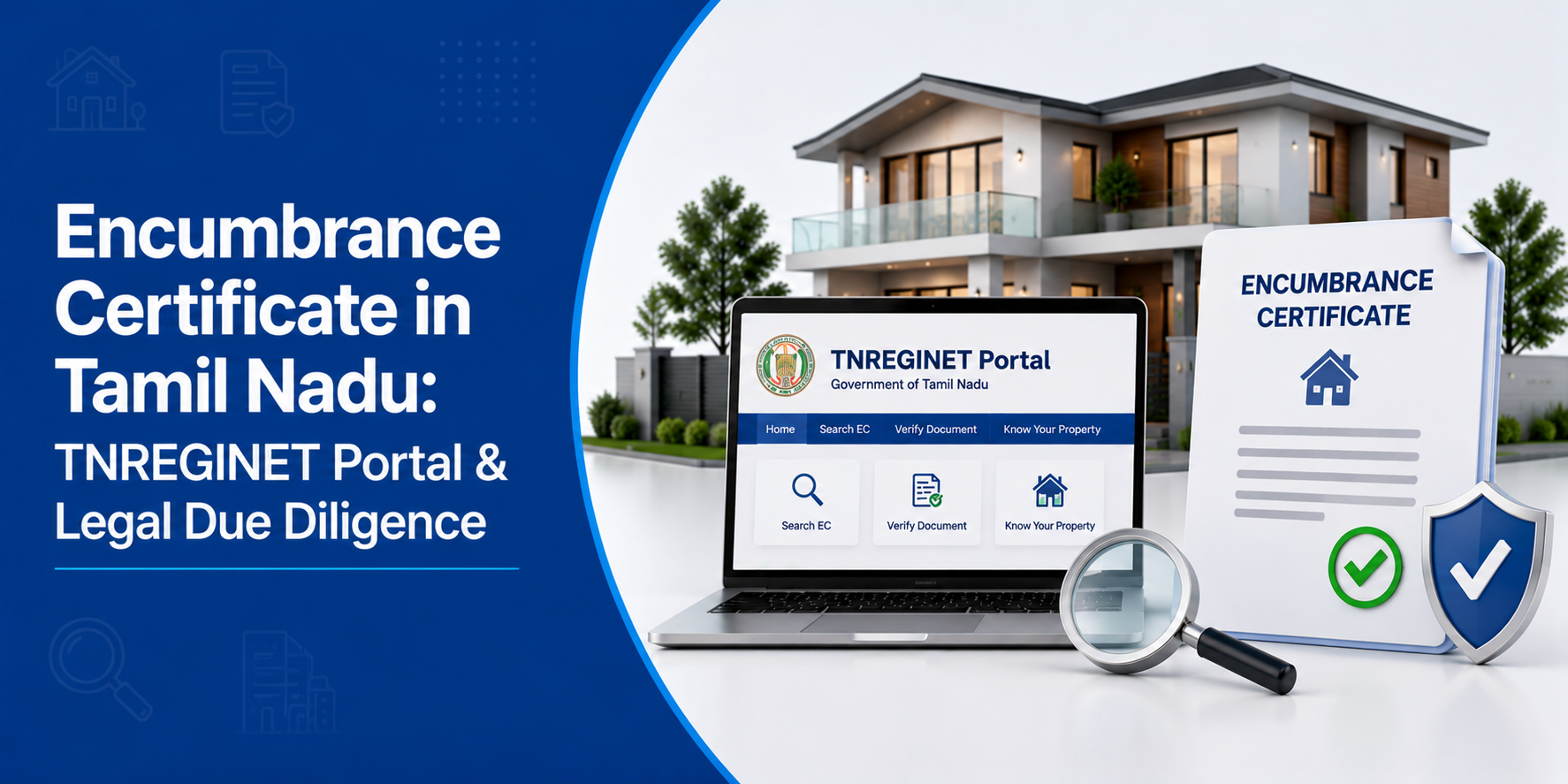

Tamil Nadu has one of India’s oldest and most robust property registration systems. The tnreginet portal (https://tnreginet.gov.in) has revolutionised how property documents are accessed and verified. Whether you’re a first-time home buyer in Chennai, Coimbatore, or Madurai, understanding how to obtain and verify an Encumbrance Certificate through tnreginet is essential.
Tamil Nadu’s registration system is particularly strict about document verification, which means the EC you get here is highly credible and trusted by all lenders.
TL;DR
- tnreginet.gov.in is Tamil Nadu’s official portal for EC applications
- Fees start as low as Rs. 15 for the first year
- EC can be downloaded digitally within 24-48 hours in many cases
- The portal allows search for up to 13 years by default (30+ years on request)
- Tamil Nadu has 38 Sub-Registrar offices across the state
Understanding Tamil Nadu’s Registration System
Tamil Nadu follows the Registration Act, 1908, meticulously. Every property transaction—sale, mortgage, gift, or partition—must be registered at the Sub-Registrar’s Office. This creates a comprehensive record that appears in the EC.
The tnreginet portal has integrated all Sub-Registrar offices across 38 locations. You can apply from any location in India and the application automatically routes to the correct office based on your property’s taluk and district.
Step-by-Step: Applying for EC on tnreginet Portal
Step 1: Visit tnreginet.gov.in Go to the official Tamil Nadu registration portal and click on “Encumbrance Certificate” or “eServices.”
Step 2: Select Applicant Type Choose whether you’re applying as:
- Property owner
- Authorized representative
- Lender (banks applying on behalf of loan applicants)
Next Step 3: Provide Property Details Enter your property’s:
- District
- Taluk (subdivision)
- Village/Town
- Survey Number (crucial—must match revenue records exactly)
- Extent of property (in acres/cents)
Step 4: Choose Search Period Default search is 13 years. You can request 30 years or more. The fee increases proportionally. For home loans, lenders typically ask for 30 years.
Step 5: Upload Documents Minimal document requirement:
- Digital copy of sale deed or title document
- Identity proof of applicant
- Authority letter (if applying on behalf of someone)
Step 6: Make Payment Payment structure in Tamil Nadu is among the most affordable:
- 1 year: Rs. 15
- 5 years: Rs. 60
- 13 years: Rs. 160
- 30 years: Rs. 360
Pay online via net banking, UPI, or credit card.
Step 7: Download Certificate In many cases, the EC is ready within 24 hours. Download the digitally signed PDF from your dashboard.
Legal Validity of tnreginet EC
One key advantage of Tamil Nadu’s system: the digitally signed EC from tnreginet carries the same legal weight as a physical stamped copy. Banks, housing finance companies, and courts all accept it without question.
What to Check in Your Tamil Nadu EC
When you receive your EC, verify:
- Correct survey number matches your sale deed
- All past owners are listed in chronological order
- If any mortgage is shown, check that a release deed is also registered (indicating the loan was repaid)
- No court attachments or legal notices are mentioned
- The period covered matches what you requested
Nil Encumbrance Certificate in Tamil Nadu
Tamil Nadu frequently issues Nil ECs, especially for:
- Government-assigned properties
- First-time property transfers
- Properties with clean ownership history
A Nil EC significantly speeds up the home loan approval process.
Common Mistakes Applicants Make
Mistake 1: Incorrect Survey Number This is the #1 reason for EC rejection. The survey number must exactly match the pattas (tax document) and revenue records. If you’re unsure, visit the local Tahsildar office to confirm.
Mistake 2: Not Checking Property Boundaries A property subdivided from a larger plot might have multiple survey numbers. Make sure you’re applying for the correct one.
Mistake 3: Assuming Nil EC Means No Legal Issues A Nil EC only covers registered transactions. Unregistered agreements, oral disputes, or boundary encroachments won’t appear here.
After You Get Your EC
Once in hand, share it with your lender for verification. Home First Finance and other housing finance companies will check for:
- Existing mortgages
- Pending loan releases
- Court orders or attachments
- Revenue department dues
A clean EC accelerates your loan approval.
Conclusion
Tamil Nadu’s tnreginet portal is user-friendly, affordable, and reliable. Getting an EC here is straightforward if you have the correct property details. The low fees and fast processing make it one of the best systems in India. Start your property verification process today by logging into tnreginet.gov.in and applying for your Encumbrance Certificate.
Ready to explore home loan options? Check your eligibility with Home First Finance and calculate your EMI using our online tools.
FAQs
Q1: What’s the difference between 13-year and 30-year EC search in Tamil Nadu?
A 13-year search covers transactions of the last 13 years. A 30-year search provides a comprehensive ownership history, which lenders prefer for home loans. The 30-year search costs approximately Rs. 200 more but is worth the investment for complete due diligence.
Q2: Can I get an EC from tnreginet without uploading a sale deed?
No, a copy of the sale deed or title document is mandatory to prove your interest in the property. This ensures only legitimate applicants access the EC.
Q3: Is the digital EC from tnreginet accepted by all banks?
Yes, the digitally signed EC from tnreginet is accepted by all banks and housing finance companies across India.
Q4: How do I check my EC application status on tnreginet?
After submission, you receive a transaction number. Use this number to check status on the tnreginet portal under “Track Application” or “View Status.” It updates in real-time.
Q5: What if the EC shows an old mortgage that wasn’t cleared?
Contact the original lender to request a release deed. Once the release is registered, your EC will reflect it. Until then, you cannot get a fresh home loan on that property.