Land Records Explained: Types, Documents, State Portals & Property Verification in India
Anurag Sodani • June 29, 2026
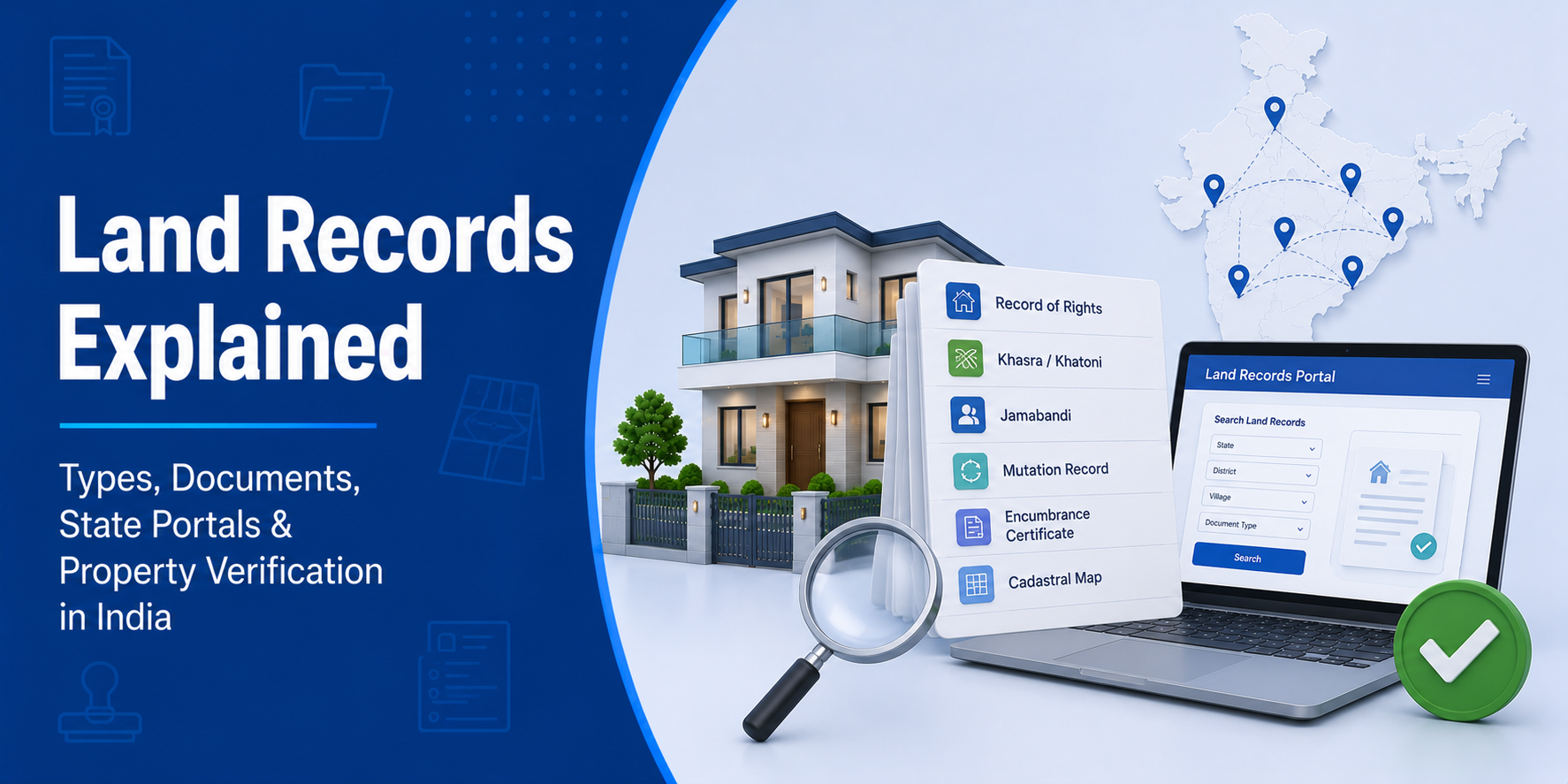

For anyone buying property in India — whether a plot of agricultural land in Rajasthan or a residential site in Bengaluru — understanding types of land records India maintains is not optional. It is the foundation of safe property ownership. India’s land record system is multi-layered, with different documents serving different purposes, different state-specific names for similar records, and multiple government departments involved. This guide breaks it all down clearly so you know exactly what to look for, where to find it, and how to use it.
Why Are Land Records Important Before Buying Property?
Land disputes are among the most common civil litigation categories in India, often stretching for years or even decades. Most disputes trace back to one root cause: buyers who did not verify land records thoroughly before purchase.
Land records matter because they:
- Establish the legal owner’s identity at the government revenue level
- Reveal existing encumbrances, mortgages, or legal charges on a property
- Confirm the size, classification, and permitted use of a parcel
- Track the complete ownership history — how the land changed hands over time
- Form the backbone of home loan legal verification by banks and HFCs
- Enable mutation (name transfer) after purchase to register you as the new owner in government records
Without verified land records, you risk buying disputed property, property with hidden mortgages, or land classified as agricultural that cannot legally host residential construction.
What Documents Are Included in Land Records?
India’s land record system comprises several inter-linked documents. Here is a comprehensive breakdown:
1. Record of Rights (RoR)
The State Revenue Department maintains RoR which is the primary land ownership document. It records:
- Name of the owner (and co-owners, if any)
- Survey or khasra number of the plot
- Total area and sub-division details
- Nature of possession (owned, tenanted, mortgaged)
- Land classification (agricultural, residential, commercial, forest, government)
- Rights and liabilities attached to the parcel
State-specific names for RoR:
| State | Local Name for RoR |
|---|---|
| Maharashtra | 7/12 (Satbara Utara) |
| Karnataka | RTC / Pahani |
| Andhra Pradesh / Telangana | Pahani / Adangal |
| Rajasthan / Haryana / Punjab | Jamabandi / Fard |
| Uttar Pradesh / MP / Bihar | Khatauni |
| Tamil Nadu | Patta / Chitta |
| West Bengal / Odisha | Khatian |
2. Mutation Register (Dakhil Kharij / Intkal)
The mutation register records all ownership changes in the revenue system after registered transactions. When you buy a property and register the sale deed, you must separately apply for mutation at the tehsildar/revenue office to update the RoR in your name.
3. Survey Number / Khasra Number
Every land parcel in India carries a plot-level identifier at the village level. In southern and western India, this is the survey number. In northern India, it is the khasra number. This number is the primary search key for all land record lookups.
4. Village Map (FMB / Shajra)
The Field Measurement Book (FMB) in Tamil Nadu and the Shajra (village map) in northern states are graphical documents showing the boundaries, shape, and relative position of every plot in a village. These are critical for resolving boundary disputes and verifying that the physical plot matches the paper record.
5. Encumbrance Certificate (EC)
Issued by the sub-registrar’s office, the EC lists all registered transactions against a property for a given period. It reveals existing mortgages, sale deeds, gift deeds, partition deeds, and court attachments. A clear EC confirms the property is free of legal and financial charges.
What is the Difference Between Land Records and Property Registration?
This distinction confuses many first-time buyers.
State revenue department mainatins Land records (RoR, Khatauni, Patta, Pahani) — typically at the tehsildar or village level. They record ownership in the revenue system and form the basis for land revenue (tax) assessment.
Property registration happens at the sub-registrar’s office (under the Registration Act, 1908). When you buy a property, you sign a sale deed that gets registered with the sub-registrar. This creates a legal record of the transaction in the registration database.
Both systems operate in parallel. Registration records the transaction. Land records (after mutation) reflect the updated ownership. A property is considered fully transferred only when both steps are complete — registration at the sub-registrar’s office AND mutation in the revenue records.
Key difference in practice:
| Aspect | Property Registration | Land Records / Mutation |
|---|---|---|
| Where | Sub-Registrar’s office | Tehsildar / Revenue office |
| What it records | The transaction (sale deed) | The updated ownership |
| Legal act | Registration Act, 1908 | State Revenue Code |
| Time to complete | Same day (appointment-based) | 30–90 days typically |
| Fee involved | Stamp duty + registration charges | Nominal mutation fee |
What is Jamabandi?
Jamabandi is the primary Record of Rights used across Rajasthan, Haryana, Punjab, Himachal Pradesh, and Jammu & Kashmir. It is prepared periodically (typically every four years) by the Patwari (village revenue official) and records:
- Owner and cultivator details
- Khasra number and area
- Type of land and irrigation source
- Nature of possession (self-cultivated, tenanted, mortgaged)
- Crop information
Jamabandi is equivalent to the 7/12 in Maharashtra or the Pahani in Andhra Pradesh — it is the comprehensive ownership and land use register for every plot in a village.
What is RTC in Land Records?
RTC stands for Record of Tenancy and Crops — it is Karnataka’s version of the Record of Rights, also called Pahani. The RTC (available through Bhoomi Karnataka) contains:
- Owner’s name and type of ownership
- Survey number and area
- Land classification (dry/wet/garden)
- Nature of possession and tenancy details
- Crop and irrigation details
- Any loans or encumbrances against the parcel
For land verification in Karnataka, the RTC is the first document to pull. It is updated by the village accountant and is now fully accessible online through the Bhoomi portal.
What is Khata?
Khata is an account number in the municipal or revenue records that links a property to its owner for taxation purposes. The term is most prominently used in:
- Karnataka (urban areas): BBMP Khata (A-Khata and B-Khata) for properties in Bengaluru
- Andhra Pradesh / Telangana: Municipal Khata for urban properties
- Revenue records across states: Khata number as an account identifier in the Khatauni
An A-Khata in Karnataka means the property is legally sanctioned and included in the official BBMP records — eligible for building plan approval, trade licenses, and home loans. A B-Khata indicates irregularities (unauthorised construction or revenue site) — home loans are generally not available for B-Khata properties without regularisation.
What is Patta?
Patta is the government-issued certificate confirming land ownership, primarily used in:
- Tamil Nadu — Issued by the Tahsildar, now in the form of a Patta Passbook
- Andhra Pradesh / Telangana — Pattadar Passbook issued to owners
- Odisha — RoR called Patta
A Patta records the owner’s name, survey number, area, land classification, and assessment details. In Tamil Nadu, Patta and Chitta (land classification record) were merged into a single Patta Passbook document, accessible online via eServices TN.
For home loans on properties in Tamil Nadu, a valid Patta in the seller’s name is essential before lenders proceed with legal verification.
How Can I Verify Agricultural Land Ownership?
Agricultural land verification requires extra care because:
- Agricultural land is governed by state-specific tenancy and land ceiling laws
- In most states, non-agriculturalists cannot purchase agricultural land without government permission
- Agricultural land cannot be used for residential construction without land use conversion (change of land use / CLU approval)
Steps to verify agricultural land ownership:
- Pull the RoR (Khatauni / Pahani / Jamabandi / 7/12) from the state portal — confirm owner, area, and classification as agricultural
- Check the mutation register for any pending or disputed transfers
- Get the EC from the sub-registrar for the past 30 years
- Verify the village map (Shajra / FMB) to confirm the physical boundaries match the paper record
- Check whether the state allows the buyer’s category (agriculturalist / non-agriculturalist) to purchase
- If you plan to construct a home, check CLU (change of land use) approval from the local authority
What is Bhu Aadhaar (ULPIN)?
Department of Land Resources assigns Bhu Aadhaar—formally called ULPIN (Unique Land Parcel Identification Number)—as a 14-digit geo-coordinate-based identifier to every land parcel in India under the DILRMP programme.
ULPIN works like a national PAN card for land. It links all existing state-level identifiers — khasra numbers, survey numbers, patta numbers, and 7/12 extract numbers — under one permanent, geo-referenced national identity. This makes cross-state verification possible and significantly reduces the risk of fraudulent record manipulation.
As ULPIN adoption spreads across states, it will eventually become the universal entry point for any land record search in India — replacing the current state-by-state, portal-by-portal process.
Can Land Records Be Corrected?
Yes. Land record corrections are possible and handled through the state revenue department. Common correction scenarios include:
- Wrong name due to spelling error or clerical mistake
- Wrong area recorded (less or more than actual)
- Wrong survey number mapped to a plot
- Incorrect land classification
How to apply for correction:
- File a written petition at the Tahsildar / Revenue Officer’s office with supporting documents
- In most states, online grievance filing is available through the state land records portal
- The revenue officer conducts a field inquiry and corrects the record after verification
- Complex disputes (ownership conflicts between parties) go to the Revenue Court
How long does land mutation take?
Standard mutations take 30 to 90 days in most states. Online mutation portals in UP, Bihar, Karnataka, and Maharashtra allow status tracking. Delays typically occur when supporting documents are incomplete or when there is a competing claim.
How Do I Check Encumbrance on a Property?
The Encumbrance Certificate (EC) is your primary tool for checking charges against a property. Here is how to access it online by state:
- Tamil Nadu: TNREGINET portal → Encumbrance Certificate search by document number or property details
- Andhra Pradesh: AP Registration & Stamps
- Karnataka: Kaveri Online Services
- Maharashtra: IGR Maharashtra
- Rajasthan: IGRS Rajasthan
Request the EC for at least the past 15–30 years to capture any long-standing mortgages or legal charges.
Can Banks Verify Land Records for Home Loans?
Yes. When you apply for a home loan, the lender’s legal team conducts a full property verification before approving the loan. This typically includes:
- Pulling the current RoR extract from the state portal
- Checking the EC for any existing mortgages
- Verifying mutation completeness
- Reviewing the sale deed chain (chain of title) for at least 30 years
- Confirming land type suitability for the loan purpose
For properties in states with ULPIN implementation, lenders can conduct significantly faster verification by querying the geo-referenced national parcel record. As ULPIN adoption grows, home loan legal verification timelines — currently two to four weeks in many cases — should shorten considerably.
Use a home loan EMI calculator to plan your monthly repayment while your legal verification process runs in parallel.
The DILRMP Programme and Digital Land Records
The Digital India Land Records Modernisation Programme (DILRMP), launched by the Ministry of Rural Development, is the national framework driving India’s land digitisation effort. Its key components include:
- Computerisation of Records of Rights (RoR) across all states
- Digitisation of cadastral maps (village land maps)
- Integration of registration and revenue records
- Implementation of ULPIN (Bhu Aadhaar) for all parcels
- Online mutation processing across states
- Integration with the NGDRS (National Generic Document Registration System) for property registration
As of 2025–26, most Indian states have digitised their RoR records. Cadastral map digitisation and ULPIN rollout are ongoing. The end goal is a unified national land information system where every parcel’s ownership, transaction history, boundaries, and legal status are accessible through a single, authenticated query.
FAQs on Types of Land Records and Property Verification
Q: What documents are included in land records?
Land records include the Record of Rights (RoR), mutation register, survey number / khasra records, village maps (FMB / Shajra), and in urban areas, Khata certificates. The Encumbrance Certificate (from the sub-registrar) is a closely linked document essential for property verification.
Q: How do I know who owns a property?
Pull the current RoR from the state portal using the survey or khasra number. The owner’s name appears in the ownership column. Cross-verify with the EC to confirm no recent unregistered transfers.
Q: How can I verify agricultural land ownership?
Check the state land records portal for the RoR (Khatauni/Pahani/Jamabandi/7/12), confirm the owner’s name and area, get the EC for the past 30 years, verify the village map for boundary accuracy, and consult a lawyer to confirm the buyer’s eligibility to purchase agricultural land in that state.
Q: What is the difference between Patta, Khata, and RoR?
RoR is the comprehensive ownership record maintained by the revenue department. Patta is the government-issued certificate confirming ownership, primarily used in Tamil Nadu, Andhra Pradesh, and Odisha. Khata is an account-level identifier used in municipal records, particularly for urban property tax purposes in Karnataka and Andhra Pradesh.
Q: What is Bhu Aadhaar and why does it matter?
Bhu Aadhaar (ULPIN) is a 14-digit geo-coordinate-based national land parcel identifier under the DILRMP. It links all state-level land identifiers under one permanent national ID, making verification faster and fraud significantly harder.
Q: Can land records be corrected?
Yes. Errors in land records — wrong names, wrong area, wrong classification — can be corrected by filing a petition at the Tahsildar or revenue office with supporting documents. Online grievance portals are available in most states.
Q: Why are land records important before buying property?
Verified land records confirm you are buying from the legal owner, reveal any existing mortgages or disputes, confirm land type and permitted use, and enable smooth home loan processing. Skipping this step is one of the most common causes of costly property disputes.
Q: How long does land mutation take?
Most states process mutations in 30 to 90 days. Delays occur when documents are incomplete or when there is a competing ownership claim. Several states — including UP, Bihar, Karnataka, and Maharashtra — now offer online mutation applications and status tracking.
Conclusion
Understanding types of land records India maintains — from the 7/12 in Maharashtra to the Jamabandi in Rajasthan, from the Pahani in Andhra Pradesh to the Patta in Tamil Nadu — is a prerequisite for any property buyer, homeowner, or borrower. These documents are not mere paperwork. They are the legal foundation of your ownership claim, your home loan eligibility, and your protection against fraud.
India’s land digitisation push under DILRMP and ULPIN is making verification faster and more reliable every year. But the responsibility to verify before you buy remains yours. Use state portals to check records online, get a certified EC, confirm mutation is complete, and consult a property lawyer for significant purchases.
If you are planning to finance your home with a loan, learn more about the home loan process and documentation and explore further property guidance on the HomeFirst Finance blog.